



Learn more about Autism Statistics
Understanding the landscape of autism spectrum disorder (ASD) starts with looking at the numbers. For parents, caregivers and educators in Missouri, state-specific statistics offer far more than simple data points – they reveal how early screening is improving, how access to care is expanding and where families can find crucial community support.
Data from the Centers for Disease Control and Prevention (CDC) and the Missouri Autism and Developmental Disabilities Monitoring (MO-ADDM) Project show that autism is increasingly recognized across diverse communities in the state. By examining these numbers, families can better navigate developmental milestones, access early intervention programs and secure individualized support for their children.
What is the Prevalence of Autism in Missouri?
According to data compiled by the MO-ADDM Project, approximately 1 in 41 children (or 2.5%) aged 8 years in tracked Missouri communities has been identified with autism spectrum disorder1. While this rate is slightly below the national average reported across all CDC monitoring sites, it reflects a significant upward trend in diagnosis and community awareness over the last two decades.2
Key prevalence insights for Missouri include …
- Gender Disparities: Similar to national trends, autism is diagnosed much more frequently in boys than in girls. In Missouri, 4-year-old boys are roughly 2.6 to 4 times more likely to be identified with ASD than girls.
- Co-Occurring Conditions: Approximately 32% of 8-year-old children identified with ASD in Missouri also have an intellectual disability (defined as an IQ score of 70 or below), highlighting the need for varied, specialized behavioral and educational strategies.
- Broadening Reach: Recent tracking shows increased identification among Black and Asian/Pacific Islander children in Missouri, signaling that historical diagnostic gaps among minority populations are beginning to close as community awareness and screening tools improve.
How Are Early Diagnosis Rates Changing in Missouri?
One of the most encouraging trends in Missouri’s autism data is the steady push toward early identification. Catching developmental delays early allows families to access evidence-based interventions during the period when a child’s brain is most adaptable.
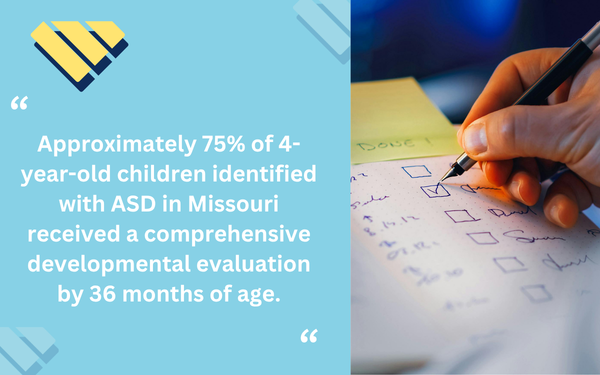
Missouri has made measurable progress in early evaluation.
- Earlier Screening: Approximately 75% of 4-year-old children identified with ASD in Missouri received a comprehensive developmental evaluation by 36 months of age.
- Cohort Comparisons: Children born in 2016 were almost 1.8 times as likely to receive an ASD diagnosis or special education classification by 48 months of age compared to children born just four years earlier in 2012.3
Statewide initiatives such as Missouri’s First Steps program (Part C of the Individuals with Disabilities Education Act) play a vital role by providing early intervention services to infants and toddlers from birth to age 3. When pediatricians and parents identify signs of autism early, toddlers can seamlessly transition into specialized programs like Applied Behavior Analysis (ABA therapy).4
What Trends Exist Across Missouri Communities?
While diagnostic rates are improving, analyzing Missouri’s data reveals ongoing shifts in how autism presents across different demographic groups and regions.
Closing Diagnostic Gaps
Historically, children from ethnic minority backgrounds or lower-income households experienced delayed evaluations. MO-ADDM reports indicate that diagnostic rates among Black and Asian/Pacific Islander children in Missouri have caught up to, and in some areas exceeded, identification rates among White children.
This shift suggests that community outreach, public school screenings and Medicaid-funded evaluations are successfully identifying children who might have previously gone undiagnosed.
Urban vs. Rural Access
Data collection for the MO-ADDM project primarily focuses on Eastern Missouri counties, including St. Louis City, St. Louis County, St. Charles, Jefferson and Franklin counties5. Families in metropolitan areas generally have broader access to pediatric specialists and ABA centers, whereas rural Missouri families often face longer travel times or waitlists for specialized diagnostic clinics and therapy centers.
Blue Gems ABA Supports Missouri Families Following a Diagnosis
Behind every statistic is a child with unique strengths, preferences and potential – and a family seeking the best path forward. A formal diagnosis is simply the first step in unlocking the personalized care and resources your child needs to thrive.
At Blue Gems ABA, we provide comprehensive, compassionate ABA therapy tailored to each child’s individual profile. Whether your child was recently identified through early intervention screening or is navigating new challenges as they grow, our experienced team collaborates closely with parents, schools and healthcare providers across Missouri.
Our approach focuses on:
- Individualized Treatment Plans: Developing goals that build essential communication, social interaction and self-regulation skills
- Early Intervention Services: Utilizing play-based, naturalistic ABA strategies for young children to build foundational skills during critical early years
- Family-Centered Support: Empowering parents with practical strategies and training to ensure progress continues seamlessly at home and in the community
If you have questions about an autism diagnosis or are looking for high-quality ABA therapy in Missouri, please contact us today.
References
- CDC. Missouri Autism and Developmental Disabilities Monitoring (MO-ADDM) Program Community Report.
- Washington University in St. Louis. Missouri Autism and Developmental Disabilities Monitoring (MO-ADDM) Project.
- Washington University in St. Louis. Missouri Autism and Developmental Disabilities Monitoring (MO-ADDM) Project.
- Missouri Department of Elementary and Secondary Education. First Steps Early Intervention Program.
- Washington University in St. Louis. Missouri Autism and Developmental Disabilities Monitoring (MO-ADDM) Project.
