



When a parent or caregiver begins noticing subtle differences in how their child communicates, plays or handles daily transitions, they often start searching for answers. During this process, many encounter the term “high-functioning autism.”
While “high-functioning autism” is not an official clinical diagnosis,1 it is a common term used to describe individuals on the autism spectrum who have strong verbal skills and average or above-average intellectual abilities, but still experience significant challenges with social communication, executive functioning and sensory processing.2
Because these individuals often navigate school or daily routines without obvious language delays, their challenges can sometimes be overlooked, misattributed to shyness or misdiagnosed as anxiety or ADHD.11 Understanding the symptoms of high-functioning autism allows parents to seek early support and tailor interventions to their child’s unique needs.12
In this article, we will examine what the term high-functioning autism means, highlight its primary symptoms and explain how personalized support such as Applied Behavior Analysis (ABA therapy) can help children thrive.
Key Takeaways
- “High-functioning autism” is not an official diagnosis; clinicians use Autism Spectrum Disorder and describe the level of support a person needs.
- Possible signs can involve social communication, focused interests, sensory processing, routines and transitions, and executive functioning.
- Strong language or academic abilities do not necessarily mean a child has no meaningful support needs.
- Individualized support can focus on practical skills such as communication, emotional regulation, independence and flexibility.
What Does ‘High-Functioning Autism’ Mean?
In formal medical settings, professionals use the diagnostic term Autism Spectrum Disorder (ASD), categorized by levels of support needed (Level 1, Level 2 or Level 3).3
What was historically called “Asperger’s syndrome” or high-functioning autism generally aligns with ASD Level 1, meaning the individual requires support to navigate daily social and behavioral demands.3
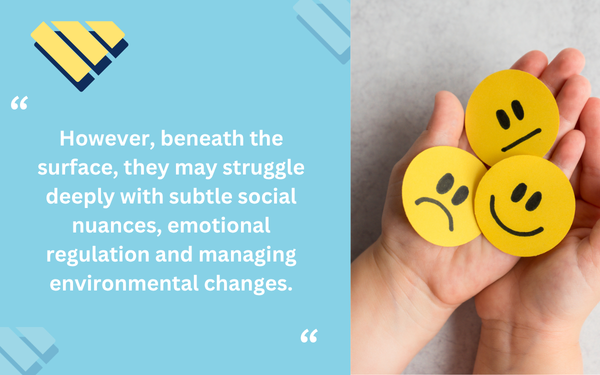
Children with high-functioning autism often express themselves fluently and excel in academic subjects. However, beneath the surface, they may struggle deeply with subtle social nuances, emotional regulation and managing environmental changes.5
Key Symptoms of High-Functioning Autism
Because autism manifests differently in every child, symptoms can vary widely in intensity and expression. However, several core characteristics are commonly associated with high-functioning autism.2
Unique Communication and Conversation Styles
While children with high-functioning autism typically possess strong vocabularies and correct grammar, they often process communication in distinct ways.4
- Literal Interpretation: They often interpret language very literally, making it difficult to understand idioms, sarcasm, jokes or metaphors.5
- Monopolizing Conversations: A child might speak at length about a favorite subject without noticing whether the listener is engaged or interested.6
- Tone and Cadence Differences: Speech may sound unusually formal, monotone or pitch-varied compared to peers.4
- Subtle Non-Verbal Challenges: Maintaining comfortable eye contact, interpreting facial expressions or reading body language can feel unnatural or taxing.7
Deep, Highly Focused Interests
A defining feature of high-functioning autism is the development of intense, specialized interests. A child might become an absolute expert in a specific topic, such as train schedules, geography, astrophysics, video game mechanics or historical events.8
While these passions are a major strength and source of joy, they can sometimes make it challenging for the child to engage in reciprocal conversations or shift their focus to other required tasks.6
Sensory Sensitivities
Many children with high-functioning autism experience sensory processing differences. They may be hypersensitive (over-reactive) or hyposensitive (under-reactive) to stimuli in their environment, such as:8
- Discomfort with bright fluorescent lights, loud sounds or crowded places
- Strong aversion to specific clothing textures, tags or food consistencies
- Seeking out strong sensory input through spinning, rocking or repetitive hand movements (“stimming”) to self-regulate.5
Need for Routine and Difficulty with Transitions
Consistency provides a crucial sense of safety. Unexpected changes to a routine such as a substitute teacher, an alternate route home or a cancelled playdate can trigger intense anxiety or behavioral distress.5
Children may stick rigidly to specific rituals or rules and experience frustration when others do not follow them with the same precision.8
Challenges with Executive Functioning
Executive functioning skills allow us to plan, organize, manage time and execute multi-step tasks. Even intellectually gifted children with high-functioning autism may struggle to:910
- Keep track of personal belongings or school assignments
- Break down a complex homework project into manageable steps
- Transition smoothly from an enjoyable activity (such as playing a video game) to a necessary task (such as getting ready for bed)
| Area | Possible Signs | How It May Appear in Daily Life |
|---|---|---|
| Communication | Literal interpretation, conversational differences, or difficulty reading non-verbal cues | Difficulty understanding sarcasm, recognizing when someone loses interest, or interpreting facial expressions |
| Focused Interests | Intense or highly specialized interests | Developing extensive knowledge about a favorite subject or having difficulty shifting attention away from it |
| Sensory Processing | Over- or under-reactivity to sensory input | Sensitivity to sounds, lights, clothing textures or foods, or seeking sensory input through repetitive movement |
| Routines and Transitions | Preference for predictability and difficulty with unexpected changes | Distress when schedules change, plans are cancelled or familiar routines are disrupted |
| Executive Functioning | Challenges with planning, organization, time management or shifting between tasks | Losing assignments, struggling with multi-step projects or having difficulty stopping a preferred activity |
How ABA Therapy Supports Children with High-Functioning Autism
Because children with high-functioning autism possess many natural strengths, interventions such as ABA therapy focus on filling in specific skill gaps while building on their existing talents.1315
Rather than trying to change who a child is, modern ABA therapy helps them develop practical strategies to navigate a world that isn’t always built for neurodivergent individuals. A Board Certified Behavior Analyst (BCBA) designs an individualized program that may focus on:1416
- Advanced Social Skills: Practicing back-and-forth conversation, understanding different perspectives and making friends
- Emotional Regulation: Learning to recognize early signs of frustration or overwhelm and using self-soothing or coping techniques
- Adaptive Independence: Building routines for homework, hygiene and daily organization that foster confidence and autonomy
- Flexibility Training: Helping children feel more comfortable when plans change unexpectedly
Blue Gems ABA Helps Your Child Reach Their Potential
Recognizing the signs of high-functioning autism is the first step toward getting your child the right support. With early identification, understanding and individualized care, children on the spectrum can build strong self-advocacy skills, excel academically and form meaningful connections.1213
At Blue Gems ABA, our dedicated team of BCBAs and Registered Behavior Technicians provides compassionate, personalized ABA therapy tailored to your child’s unique personality and strengths. We collaborate closely with families to ensure progress in our clinics, in your home and out in the community.
To learn more about how our individualized ABA programs can help your child navigate daily life with confidence, please contact us today.
Frequently Asked Questions
- Is high-functioning autism an official diagnosis?
No. Clinicians diagnose Autism Spectrum Disorder (ASD) and may describe the level of support an individual needs. - What are common signs associated with high-functioning autism?
Signs can include differences in social communication, highly focused interests, sensory sensitivities, a strong preference for routines and executive functioning challenges. Symptoms and support needs vary from child to child. - Can a child with strong verbal skills still have autism?
Yes. Strong vocabulary or fluent speech does not rule out autism because a child may still experience significant differences in social communication, flexibility, sensory processing or other areas. - Why can signs of autism sometimes be overlooked?
Some children have subtle symptoms, typical cognitive abilities or strong language skills, which can make their support needs less immediately apparent. Co-occurring conditions such as anxiety or ADHD can also complicate identification. - How can ABA therapy support children on the autism spectrum?
ABA-based interventions may target individualized skills such as communication, adaptive behavior, social interaction and daily independence. Goals and strategies should be tailored to the individual child’s needs.
References
- Centers for Disease Control and Prevention (CDC). “Clinical Testing and Diagnosis for Autism Spectrum Disorder.” https://www.cdc.gov/autism/hcp/diagnosis/index.html
- National Institute of Mental Health (NIMH). “Autism Spectrum Disorder.” https://www.nimh.nih.gov/health/publications/autism-spectrum-disorder
- Centers for Disease Control and Prevention (CDC). “Clinical Testing and Diagnosis for Autism Spectrum Disorder.” https://www.cdc.gov/autism/hcp/diagnosis/index.html
- American Speech-Language-Hearing Association (ASHA). “Autism and Autism Spectrum Disorder.” https://www.asha.org/practice-portal/clinical-topics/autism/
- National Institute for Health and Care Excellence (NICE). “Features Suggesting Possible Autism.” https://www.nice.org.uk/guidance/cg128/chapter/Appendix-Features-suggesting-possible-autism
- National Institute of Mental Health (NIMH). “Autism Spectrum Disorder.” https://www.nimh.nih.gov/health/publications/autism-spectrum-disorder
- Centers for Disease Control and Prevention (CDC). “Clinical Testing and Diagnosis for Autism Spectrum Disorder.” https://www.cdc.gov/autism/hcp/diagnosis/index.html
- Centers for Disease Control and Prevention (CDC). “Clinical Testing and Diagnosis for Autism Spectrum Disorder.” https://www.cdc.gov/autism/hcp/diagnosis/index.html
- Frontiers in Human Neuroscience / PubMed Central. “Review of Executive Function Deficits in ASD and ADHD.” https://pmc.ncbi.nlm.nih.gov/articles/PMC4869784/
- JCPP Advances / PubMed Central. “Executive Function Profiles of Preschool Children With ASD and ADHD: Systematic Review.” https://pmc.ncbi.nlm.nih.gov/articles/PMC10241451/
- American Academy of Pediatrics. “Identification, Evaluation, and Management of Children With Autism Spectrum Disorder.” https://publications.aap.org/pediatrics/article/145/1/e20193447/36917/Identification-Evaluation-and-Management-of
- American Academy of Pediatrics. “Early Identification of Autism Spectrum Disorder: Recommendations for Practice and Research.” https://publications.aap.org/pediatrics/article/136/Supplement_1/S10/33964/Early-Identification-of-Autism-Spectrum-Disorder
- American Academy of Pediatrics. “Early Intervention for Children With Autism Spectrum Disorder Under 3 Years of Age.” https://publications.aap.org/pediatrics/article/136/Supplement_1/S60/33948/Early-Intervention-for-Children-With-Autism
- Behavior Analyst Certification Board (BACB). “Behavioral Treatment of Autism and Other Developmental Disabilities.” https://www.bacb.com/about-behavior-analysis/treatment-of-autism-and-other-developmental-disabilities/
- Autism / PubMed Central. “Intensive Behavioural Interventions Based on Applied Behaviour Analysis: Individual Participant Data Meta-Analysis.” https://pmc.ncbi.nlm.nih.gov/articles/PMC8108110/
- Behavior Analysis in Practice / PubMed Central. “Applied Behavior Analysis in Children and Youth With Autism Spectrum Disorders: A Scoping Review.” https://pmc.ncbi.nlm.nih.gov/articles/PMC9458805/
