


Applied behavior analysis (ABA therapy) is widely recognized by medical professionals, educators and insurance providers as the gold-standard treatment for individuals with autism spectrum disorder (ASD). Decades of research have shown its effectiveness in helping children build foundational skills, improve communication and foster independence.123
At the same time, parents navigating an autism diagnosis often encounter mixed opinions, online debates and lingering criticisms surrounding the therapy. If you are a parent exploring care options, hearing conflicting perspectives can feel overwhelming and confusing.
To make informed decisions for your child, it is helpful to understand both what modern ABA therapy is and why historical controversies exist. In this article, we will explain the foundations of ABA therapy, address the main sources of controversy and highlight how contemporary practices prioritize compassionate, child-centered care.
Key Takeaways
- ABA applies principles of behavior and learning to help develop meaningful skills.
- Much of the controversy surrounding ABA relates to historical practices, rigid compliance and concerns about masking.
- Contemporary approaches increasingly emphasize individualized goals, assent, naturalistic teaching and functional communication.
- Families can consider both the evidence for ABA-based interventions and concerns raised by autistic people and advocates when evaluating care.
What is ABA Therapy?
ABA therapy is an evidence-based approach focused on understanding how behavior works, how it is affected by the environment and how learning takes place.1 When applied to autism care, ABA breaks down complex skills such as speaking, socializing or completing daily routines into small, achievable steps.
Rather than taking a generic approach, ABA programs are customized to each child’s unique strengths, preferences and developmental needs.14 Through positive reinforcement, therapists encourage helpful behaviors that make daily life safer, richer and more fulfilling.
Why is ABA Therapy Controversial?
The controversy surrounding ABA therapy primarily stems from its early history, older clinical methodologies and concerns regarding how therapies were conducted decades ago. Understanding these concerns helps clarify how far the field has progressed.
Historical Practices and Rigid Compliance
ABA therapy was developed in the mid-20th century, and early iterations of the therapy often relied on rigid compliance training. Historically, some practitioners focused heavily on making children with autism behave in ways that appeared “neurotypical,” sometimes using aversive techniques or strict repetition.4
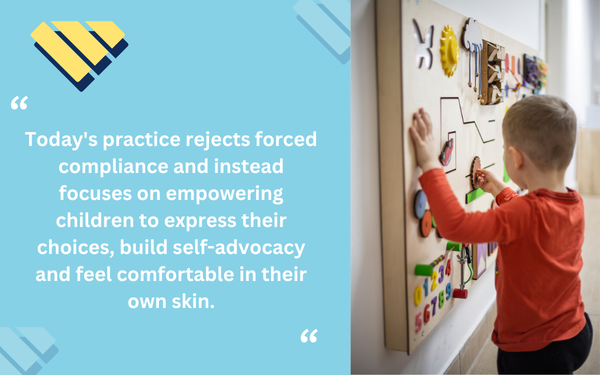
Modern ABA has completely moved away from aversive methods. Today’s practice rejects forced compliance and instead focuses on empowering children to express their choices, build self-advocacy and feel comfortable in their own skin.56
| Area | Historical ABA Concerns | Modern ABA Approaches Discussed in This Article |
|---|---|---|
| Participation | Rigid compliance training and highly structured expectations | Attention to assent, choices, boundaries and engagement |
| Self-expression | Efforts to suppress behaviors that appeared different or non-neurotypical | Greater recognition of self-regulation, individual preferences and meaningful goals |
| Teaching environment | Highly structured and repetitive instruction | Play-based and naturalistic learning during everyday activities |
| Communication | Greater emphasis on conventional responses or speech | Functional communication through speech, signs, pictures or AAC |
| Intensity | Intensive programs historically associated with schedules of up to 30–40 hours per week | Individualized recommendations based on goals and needs |
Concerns About Masking and Self-Expression
Critics and neurodiversity advocates have raised concerns that older ABA models taught children to suppress natural behaviors such as repetitive movements or “stimming,” which many neurodivergent individuals use to regulate stress or sensory input.78
In contemporary practice, Board Certified Behavior Analysts (BCBAs) recognize that stimming and self-soothing behaviors are natural and valid. Intervention is only considered if a behavior poses a physical safety risk to the child or directly inhibits their ability to learn and interact.57
Intensity and Time Commitment
Early ABA programs frequently recommended 30 to 40 hours of intensive therapy per week.9 For young children and families, such a heavy schedule can sometimes lead to fatigue or feel overwhelming alongside school and family life.
Today, ABA programs are much more flexible. Recommendations are tailored to each child’s specific developmental goals, balancing structured sessions with plenty of time for rest, unstructured play and family activities.14
How Modern ABA Has Evolved
The field of Applied Behavior Analysis has undergone significant positive transformation over the past several decades. Today’s ABA therapists are trained to uphold rigorous ethical standards, focusing on trauma-informed care and individual dignity.5
Play-Based and Naturalistic Teaching
Instead of sitting at a desk for long stretches, modern ABA often takes place during play and everyday activities. Known as Natural Environment Teaching (NET), this approach allows therapists to teach communication, motor and social skills while a child is engaged with their favorite toys, games or daily routines.1011
Focus on Assent and Emotional Well-Being
Respecting a child’s boundaries is central to modern care.56
Therapists monitor subtle verbal and non-verbal cues to ensure the child is engaged and comfortable. If a child expresses distress or frustration, the therapist adjusts the approach, takes a break or shifts to a new activity.6
Teaching Functional Communication
Rather than focusing solely on speech, modern ABA emphasizes functional communication in whatever form works best for the child, whether that involves spoken words, sign language, picture cards or alternative communication (AAC) devices.1213
Giving a child a reliable way to advocate for their needs significantly reduces distress and challenging behaviors.
Blue Gems ABA Offers Compassionate, Person-Centered Care
Understanding the history and evolution of ABA therapy allows parents to make confident choices for their family. While early forms of ABA had clear limitations, modern ABA is a compassionate, flexible and supportive framework designed to help children thrive as their authentic selves.
At Blue Gems ABA, our team of experienced BCBAs and Registered Behavior Technicians (RBTs) is committed to providing modern, ethical and individualized care. We focus on building communication, fostering independence and celebrating every child’s unique personality in a safe, nurturing environment.
If you have questions about how ABA therapy can support your child, please contact us today.
Frequently Asked Questions
- What does ABA therapy mean?
Applied Behavior Analysis is an approach that applies principles of behavior and learning to develop meaningful skills and understand how behavior relates to the environment. - Why do some people criticize ABA therapy?
Criticism includes concerns about historical use of aversive or compliance-focused practices, suppression of autistic behaviors, masking and intensive treatment schedules. Contemporary professional standards increasingly emphasize dignity, individualization and client choice. - Does modern ABA try to stop stimming?
Stimming can serve important self-regulatory functions for autistic people. Treatment decisions should be individualized rather than based simply on making a person appear more neurotypical. - How many hours of ABA therapy does a child need?
There is no single schedule appropriate for every child. Treatment intensity should be individualized according to clinical needs, goals and circumstances. - Can ABA support children who do not communicate through speech?
Communication support can include speech as well as signs, gestures, pictures and AAC systems. The appropriate method depends on the individual child’s communication abilities and needs.
References
- Centers for Disease Control and Prevention (CDC). Treatment and Intervention for Autism Spectrum Disorder. https://www.cdc.gov/autism/treatment/index.html
- American Academy of Pediatrics. Identification, Evaluation, and Management of Children With Autism Spectrum Disorder. https://publications.aap.org/pediatrics/article/145/1/e20193447/36917/Identification-Evaluation-and-Management-of
- Yu et al. Efficacy of Interventions Based on Applied Behavior Analysis for Autism Spectrum Disorder: A Meta-Analysis. PubMed. https://pubmed.ncbi.nlm.nih.gov/32375461/
- Schreibman et al. Naturalistic Developmental Behavioral Interventions: Empirically Validated Treatments for Autism Spectrum Disorder. https://pmc.ncbi.nlm.nih.gov/articles/PMC4513196/
- Behavior Analyst Certification Board. Ethics Code for Behavior Analysts. https://www.bacb.com/wp-content/uploads/2022/01/Ethics-Code-for-Behavior-Analysts-240830-a.pdf
- Behavior Analyst Certification Board. Ethics Codes. https://www.bacb.com/ethics-information/ethics-codes/
- Kapp et al. “People should be allowed to do what they like”: Autistic adults’ views and experiences of stimming. https://pmc.ncbi.nlm.nih.gov/articles/PMC6728747/
- Cook et al. Camouflaging in autism: A systematic review. PubMed. https://pubmed.ncbi.nlm.nih.gov/34563942/
- Reichow et al. Early intensive behavioral intervention (EIBI) for young children with autism spectrum disorders. Cochrane Review via PubMed. https://pubmed.ncbi.nlm.nih.gov/29742275/
- Schreibman et al. Naturalistic Developmental Behavioral Interventions: Empirically Validated Treatments for Autism Spectrum Disorder. https://pmc.ncbi.nlm.nih.gov/articles/PMC4513196/
- Project AIM. Understanding the Effects of Naturalistic Developmental Behavioral Interventions: A Meta-analysis. https://pmc.ncbi.nlm.nih.gov/articles/PMC8862714/
- American Speech-Language-Hearing Association. Autism and Autism Spectrum Disorder. https://www.asha.org/practice-portal/clinical-topics/autism/
- American Speech-Language-Hearing Association. Augmentative and Alternative Communication (AAC). https://www.asha.org/practice-portal/professional-issues/augmentative-and-alternative-communication/
- Council of Autism Service Providers. ABA Practice Guidelines (Version 3.0). https://www.casproviders.org/asd-guidelines
