


Human emotions are complex, powerful and sometimes overwhelming. For any child, figuring out how to identify a big feeling, connect a word to it and express it without throwing a tantrum is a major developmental hurdle.
When a child lacks the tools to communicate their internal state, emotional experiences often manifest as challenging behaviors such as crying, screaming, aggression or withdrawal. For children on the autism spectrum, this emotional landscape can be uniquely difficult.
Because autism spectrum disorder (ASD) frequently impacts communication, social understanding and sensory processing, autistic children often experience emotions with intense vulnerability but struggle to articulate what they are feeling.
A child who appears to be having an unprovoked meltdown may actually be trying to say, “I am incredibly overwhelmed by this loud room,” or “I feel frustrated because I can’t get this toy to work.”
When we understand that behavior is communication, we can shift our focus from merely stopping an unwanted action to teaching a functional alternative.
In this article, we will explore why emotional expression is challenging for children with autism and how applied behavior analysis (ABA therapy) structures interventions to teach children how to express their feelings appropriately.
Why is Expressing Feelings Challenging for Autistic Children?
Children on the autism spectrum face unique barriers when dealing with big feelings.
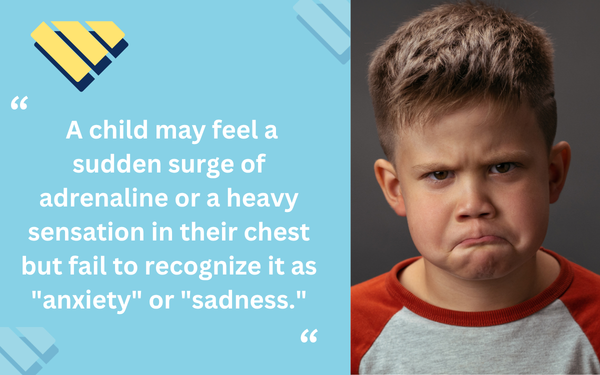
A primary obstacle is alexithymia, a condition common among individuals with autism that makes it difficult to identify and name one’s own emotions. A child may feel a sudden surge of adrenaline or a heavy sensation in their chest but fail to recognize it as “anxiety” or “sadness.”
Without an emotional vocabulary, the physical sensation simply feels alarming, frequently triggering a fight-or-flight response.
Children on the spectrum also often struggle with interoception, which is the body’s internal sensing system.
Interoception helps us notice internal cues such as a racing heartbeat, muscle tension or a fluttering stomach. If a child can’t read these physical warning signs of anger or stress, their emotions may seem to skyrocket from calm to a full meltdown with no warning.
Finally, traditional social modeling doesn’t always translate naturally for autistic children. They may not instinctively connect a peer’s furrowed brow with anger or a caregiver’s heavy sigh with fatigue, making it harder to learn emotional expression through casual observation alone.
How Does ABA Therapy Break Down Emotional Communication?
ABA therapy approaches emotional expression by transforming an abstract, internal experience into clear, teachable and observable skills. Rather than treating emotional control as a vague concept, a Board Certified Behavior Analyst (BCBA) breaks down emotional regulation into three distinct, structured milestones:
- Identification: Recognizing the physical and environmental signs of an emotion
- Labeling: Connecting a specific word, sign or visual icon to that feeling
- Replacement Behavior: Choosing a safe, functional action to communicate that feeling to others
Every individual ABA program begins with comprehensive evaluations to pinpoint a child’s current baseline. A child who communicates primarily through gestures will have different initial goals than a child who is highly verbal but uses their words to shout when upset.
By closely monitoring data collected across daily therapy sessions, the clinical team tailors programs to match your child’s exact learning style.
Clinical Strategies to Encourage Appropriate Expression
Helping a child navigate their emotional world requires blending deep empathy with systematic behavioral strategies. ABA practitioners use several proven tools to help children transition from disruptive behaviors to adaptive emotional expression.
Visual Emotion Scales and Choice Boards
Because abstract words can lose meaning when a child is entering an emotional crisis, visual aids are essential.
Therapists often use color-coded scales to help children categorize their internal state. A child can simply point to the “Red Zone” or an angry face cartoon to communicate their distress before their behavior escalates.
Functional Communication Training (FCT)
FCT is an evidence-based practice focused on replacing problem behaviors with positive, functional communication. If data shows a child screams to escape a difficult math worksheet, the therapist systematically teaches them to say “I need a break.”
By guaranteeing the appropriate phrase achieves the same relief as the scream, the unhelpful behavior naturally diminishes.
Role Playing and Behavioral Skills Training (BST)
The worst time to teach a child a coping skill is when they are in the middle of a meltdown. BST makes sure that emotional skills are taught when the child is completely calm.
Through a process of instructions, modeling, role playing and feedback, therapists practice mock frustrations with the child, giving them a safe space to rehearse taking deep breaths or asking for help.
Partnering with Families for Emotional Growth at Blue Gems ABA
Learning to express feelings appropriately is a life-changing milestone. It reduces daily family stress, minimizes behavioral crises and empowers children on the autism spectrum to advocate for their needs in classrooms and community settings.
Because emotional development looks different for every individual, a personalized, patient approach is vital.
At Blue Gems ABA, our dedicated therapy teams are committed to creating individualized, data-driven treatment plans that respect your child’s unique personality while building essential social-emotional skills.
We collaborate closely with parents and caregivers, providing the training and resources needed so that the emotional breakthroughs achieved in our centers carry over seamlessly into your home.
To learn more about how we can support your child’s behavioral health and emotional journey, please contact us today.
