


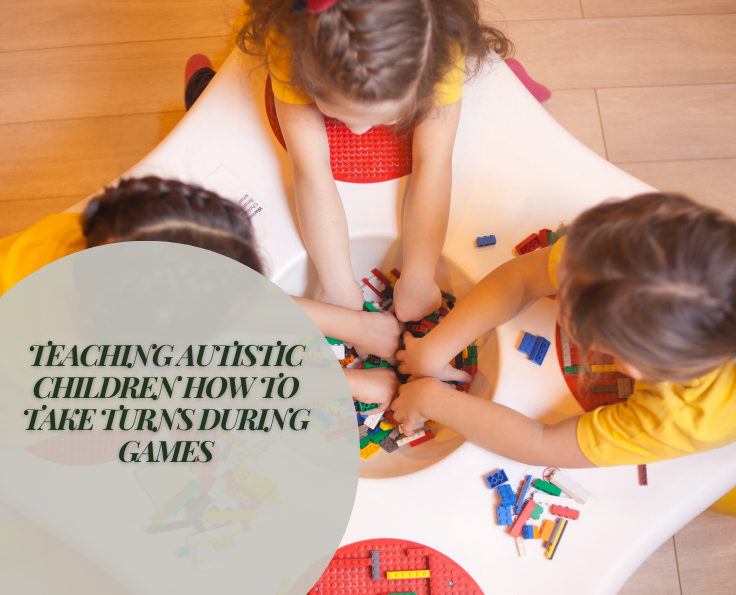
Turn taking is an important skill that children first start to learn when they are young. While the skill may seem trivial, it’s an important building block for lifelong learning, social relationships and professional opportunities.
It’s not easy to teach children how to take turns, as they are often impatient and have trouble sharing. Doing so can be even harder for children who have autism spectrum disorder (ASD), who typically face deficits in communication and social interaction when compared to their neurotypical peers.
With applied behavior analysis (ABA therapy), children with autism can learn the essential skill of taking turns — all of which starts by playing games.
In this article, we’ll detail the ABA therapy process of teaching autistic children how to take turns during games.
Key Takeaways
- Turn taking is a foundational social skill that children with autism can learn through structured ABA therapy.
- Start with simple games that have clear rules and predictable patterns.
- Use short phrases, visual aids, and modeling to help children understand whose turn it is.
- Reinforce positive behavior consistently and reduce rewards over time for long-term success.
- Every child is different — tailor strategies based on individual needs and progress.
Create a Structured Activity
ABA therapy is based on scientific evidence, so it’s no surprise that its approach is highly structured. This structure provides children with an environment they can clearly understand and feel safe in at the same time.
When teaching autistic children how to take turns, it’s best to play a game that has clear rules. It doesn’t have to be complicated; it can be as simple as bouncing a ball from one person to the next, or building a tower of blocks.
The goal is to teach the basic concept of taking turns while playing games so the child can generalize that skill to other real-world settings in the future.
When starting, it’s best to keep each person’s turn short so that it matches the child’s shorter attention span. Then, use visual cues to help them understand when it’s their turn to go.
For example, you can start by putting one block down on a table and holding up a red card to signify that it’s not the child’s turn to go. When you’re done, hold up a green card and allow them to place the next block on top.
Continue doing this, alternating turns and using the appropriate card to help them understand the concept of turn taking.
| Strategy | Why It Helps | How to Implement |
|---|---|---|
| Create a Structured Activity | Helps children understand expectations and feel secure during learning. | Use simple turn-based games (e.g., ball toss or block stacking) with visual cues like colored cards to show whose turn it is. |
| Simplify the Instructions | Improves communication and understanding for children with language processing challenges. | Use short phrases like “My turn” and “Your turn.” Model behaviors clearly and build complexity over time. |
| Reinforce the Behaviors | Strengthens learning and motivation through consistent rewards. | Use toys, praise, or tokens after each successful turn. Gradually fade reinforcements to build independence. |
Simplify the Instructions
Another important aspect of teaching turn taking is to simplify the instructions as much as possible. Focus on using simple phrases, such as “My turn” and “Your turn,” or you could insert your name and their name into the phrases.
If they make a mistake, simply correct them by saying, “No, it’s my turn,” to re-emphasize the same concept and remain consistent.
You can model each behavior that you wish the child to exhibit so they can see how it’s done. For instance, you can place the block on the table and say “My turn” while you do it. Then, you can say “Now your turn” so they know it’s their turn to go.
Eventually, you can move onto more complicated games with complex instructions and role play the scenarios so they can understand how turn taking applies to different games and situations.
Reinforce the Behaviors
As you’re teaching autistic children how to take turns during games, it’s important to reinforce the behaviors you wish for them to exhibit. In ABA therapy, this is done through positive reinforcement.
Based on evaluations and data analysis, the therapy team will select a reinforcement item and schedule for every strategy. This could be a toy that they like to play with, a token they can exchange for something later or even just extra praise.
Every time the child successfully exhibits the desired behavior, they are immediately presented with this item or praised for doing so. What this does is not only reward them for their behavior, but keep them engaged in the activity and motivated to continue behaving that way.
In terms of teaching turn taking, the therapist will present the reinforcement item to them each time the child successfully waits their turn. At first, this will be done every time, to ensure the application is consistent and that the child is being extra rewarded.
Over time, the reinforcer will fade gradually, which helps the child generalize the skills even more. This helps them exhibit turn taking behavior in the real world without the need for constant positive reinforcement to do so.
Blue Gems ABA Teaches Children with ASD to Take Turns
Turn taking is an extremely important skill to teach children. For children with ASD, this skill may take a different approach based on the symptoms of their neurodevelopmental disorder.
At Blue Gems ABA, our team of therapists builds personalized ABA therapy treatment plans that can help children with autism learn how to take turns during games. We start small and build from there, relying on data we collect to inform us of the best path forward for each individual child we serve.
To learn more, please contact us today.
FAQs
Why is turn taking difficult for children with autism?
Many children with autism have difficulty with social interaction, communication, and waiting, which are all part of turn taking.
What kind of games should I use to teach turn taking?
Start with simple, predictable games like ball rolling or stacking blocks. Gradually build toward more complex games.
How often should I reinforce turn taking?
In the beginning, reinforce every successful turn to build understanding. Over time, reduce the frequency as the behavior becomes consistent.
Can I teach turn taking at home without a therapist?
Yes, especially by using consistent routines, visual cues, and praise. However, ABA therapists can tailor strategies based on individual needs.
How does Blue Gems ABA help with this skill?
Blue Gems ABA creates personalized plans using data-driven ABA therapy methods to help children learn social skills like turn taking through play and reinforcement.
