
ABA Therapy — Managing Transitions Between Multiple Therapists

Children with autism spectrum disorder (ASD) commonly face challenges when transitioning from one activity to the next. If they know what’s coming up next, they are more likely to navigate the situation successfully, without reacting negatively.
This is why setting up clear routines is so beneficial to children with autism. It helps them feel comfortable, which removes the anxiety and stress that often causes them to get overwhelmed.
At times, of course, it’s not always possible to schedule out every part of the day. Even when this happens, though, you can help children on the autism spectrum manage transitions.
Applied behavior analysis (ABA therapy) is the gold standard treatment for children with autism, and it helps them manage transitions more successfully.
In this article, we’ll discuss one aspect of ABA therapy, managing transitions between multiple therapists.
Key Takeaways
- Routines help reduce anxiety and ease transitions for children with ASD.
- Visual tools like schedules, timers, and boards improve understanding.
- Reinforcing desired behaviors helps children stay motivated during transitions.
- Introducing changes gradually helps children adapt more comfortably.
- Parental consistency with ABA strategies boosts their effectiveness.
Table Of Contents
Create as Consistent a Routine as Possible
Children with autism may have multiple therapists that they see — both inside and outside of ABA therapy. This could include speech therapists, occupational therapists and physical therapists, to name a few, in addition to other medical providers.
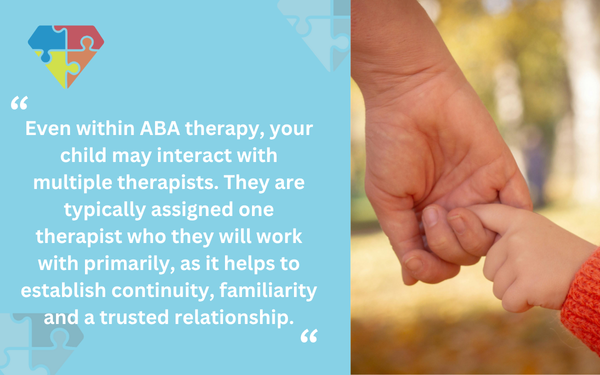
Even within ABA therapy, your child may interact with multiple therapists. They are typically assigned one therapist who they will work with primarily, as it helps to establish continuity, familiarity and a trusted relationship.
However, your child may interact with multiple RBTs and BCBAs as part of their ABA therapy.
While some of these changes will be unpredictable, it’s best to create as consistent a routine as possible. This will help them feel comfortable and know that it’s time to transition from one therapist to another.
| Strategy | Description | Tools/Tips |
|---|---|---|
| Consistent Routine | Helps children predict transitions and reduces anxiety | Try fixed schedules, routines, and therapist rotations |
| Visual Aids | Supports understanding of upcoming transitions | Visual schedules, timers, first-then boards |
| Positive Reinforcement | Encourages desirable behavior with rewards | Praise, tokens, access to preferred toys |
| Start Small | Gradual introduction of new therapists | Short sessions with overlap from familiar therapists |
Use Visual Aids
A great way to help children manage transitions between therapists is to use visual aids. Visual schedules for the day can be very effective at helping children with ASD see what the day entails.
This calendar could have pictures of what the activities for the day are, in chronological order, with words and even times next to them. You could have an arrow that moves from one activity to the next as the day progresses.
Involving your child in moving the arrow, if possible, will make it an interactive activity that they enjoy. And by participating in progressing through the visual calendar, they will more effectively grasp what’s going on.
Other helpful visual aids include first-and-then boards, with one activity in the “first” column and the next activity that will follow in the “then” column. Visual timers are also helpful in allowing children with ASD to see how much time is left with one therapist before they’ll transition to another.
Integrate Positive Reinforcement
ABA therapy uses positive reinforcement to reward children for successfully attempting new skills and behavior modifications. It also keeps them engaged in the learning and motivated to learn more.
Parents should use this concept throughout their day as children transition from one activity to the next as well. By giving them extra praise, time with a toy they love or a token they can exchange for a reward later, you will be reinforcing the desired behaviors you want them to exhibit.
When the child gets the same consistent approach and application of ABA principles, they’ll be able to more effectively navigate transitions, whether it’s from one therapist to another or from one activity to another.
This is especially helpful if the child must transition from something preferred to something non-preferred. If they know they’ll get rewarded for navigating away from the preferred activity, they’re more likely to do it — even if what’s ahead is a non-preferred activity.
Start Small
As with any new change in routine, it’s best to start small when transitioning between multiple therapists. Begin by introducing the new therapist for a little bit at a time, even with the therapist they are familiar with at first.
This will allow the child to start to understand a change and transition is coming, without dumping everything on them all at once. Following this approach will allow them to ease into the transition, which is simpler for them to understand and accept.
In the long run, that often proves to be more successful.
Blue Gems ABA Helps Children with ASD Manage Transitions
Navigating transitions are particularly challenging for children with ASD. Whether it’s from one activity to another, or transitioning between multiple therapists, ABA therapy can help provide the tools and support needed so children feel less overwhelmed and more comfortable.
At Blue Gems ABA, our team of experienced therapists can create targeted interventions to help children with autism build transition skills. It’s just one way we work every day to help the children we serve live as independently as possible.
To learn more, please contact us today.
FAQs
Q: Why do children with autism struggle with transitions?
A: Changes in activity or environment can cause anxiety due to unpredictability and sensory sensitivities.
Q: What visual tools are best for transition support?
A: Visual schedules, first-then boards, and timers help children understand what’s next.
Q: How can I make transitions smoother at home?
A: Use consistent routines, involve the child in schedule updates, and apply positive reinforcement.
Q: Can multiple therapists confuse my child?
A: Not if transitions are gradual and routines are maintained. Assigning a primary therapist also helps.
 617-297-7998
 617-340-3371


 English
  Spanish