
How ABA Therapy Changes as Children Mature
One of the best parts about applied behavior analysis (ABA therapy) is that it’s a highly personalized treatment plan. It is catered to each specific patient’s unique strength, challenges, preferences and needs so therapists can help target the most appropriate skills and behaviors for each child with autism spectrum disorder (ASD) they serve.
As children change, ABA therapy plans change with them. This includes when they accomplish their set goals, if they’re having trouble reaching their goals and as they mature.
ABA therapy treatment plans are flexible, which means that as children mature, they are adaptable to meet them where they’re at. Each child has unique needs, so therapy plans may look considerably different for even two children who are the same age.
In this article, though, we’ll look at how ABA therapy changes as children mature from a general perspective.
Table Of Contents
Early Childhood Stages
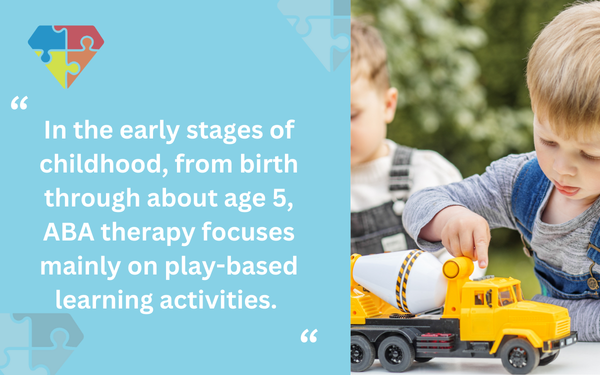
In the early stages of childhood, from birth through about age 5, ABA therapy focuses mainly on play-based learning activities. The general goal at this stage is to help children with ASD build the essential social and communication skills they often struggle with.
Common strategies that are employed to do this include Natural Environment Teaching (NET) as well as Discrete Trial Training (DTT).
NET plays into the child’s interests and natural environments, using them to teach the skills they need to gain in practical scenarios that they’re likely to encounter in their day-to-day lives.
DTT, meanwhile, is a very structured approach to teaching new skills in smaller, separate steps to children so they can more easily manage and understand them. This strategy is often used for the fundamental social skills including eye contact, motor skills and taking turns.
Throughout all methods, therapists will use prompts, visual aids and reinforcement schedules to support the children they work with and ensure they are engaged in the activities.
School Age Stage
As children become school aged and enter kindergarten, through the time they are in elementary school, ABA therapy will adjust so that the treatment plan addresses the child’s increasing developmental needs.
Each child’s plan will again be based on their specific needs and where they are at that moment. General focuses will be on preparing children for school and academic readiness, improving their social skills and helping them regulate their emotions.
At this stage, ABA therapy becomes much more structured. While there are play activities, treatments typically include things such as social stories and role playing to teach coping mechanisms and more complex interactions with peers.
These strategies will look to build upon the foundational skills acquired in early ABA therapy to take them to the next level.
In addition, ABA therapy teams will likely collaborate with teachers, other professional support people and caregivers to ensure that the skills the child is learning in therapy are being properly and consistently reinforced in all other settings.
Adolescent and Young Adult Stages
A lot changes when children become teens, and ABA therapy changes with them at this stage in their life, too. The focus of treatment at this stage often shifts to preparing them to live as adults, which includes fostering independence as much as possible.
Life skills are a big focus for adolescents and young adults, as is specific vocational training. ABA therapy will help patients at this point manage the responsibilities they have every day, with the goal being to help them transition into adulthood as smoothly as possible.
ABA therapy likely will focus on helping teens improve more sophisticated communication skills, since social interactions among their peers at this age becomes much more complex. Non-verbal cues such as sarcasm, tone of voice, gestures and facial expressions become commonplace around this age.
At the same time, emotional regulation is often a big target for ABA therapy for teens. With so many new stimuli being thrown at them, and with so much changing physically within themselves, teens with autism may experience overload quicker than before.
Helping teens manage anxiety, impulsivity and frustration are all part of what ABA therapy can offer.
All of this put together helps teens on the autism spectrum manage their emotions better, which can lead to more success as independent adults.
Blue Gems ABA Personalizes Treatment Plans to Meet Children Where They Are
ABA therapy is prized as the leading treatment for children with ASD for many reasons, but especially because it is highly flexible and customizable. As children mature, ABA therapy treatment plans will as well.
At Blue Gems ABA, we build personalized ABA therapy treatment plans that meet children where they are at that moment. We constantly collect and analyze data to ensure every child’s treatment plan reflects their current needs and adjust plans as children mature.
To learn more, please contact us today.
 617-297-7998
 617-340-3371


 English
  Spanish