



For many years, autism spectrum disorder (ASD) was primarily viewed through the lens of childhood development. As public awareness grows and diagnostic tools evolve, more adults are beginning to recognize neurodivergent traits in themselves.1
Many individuals navigate years or even decades feeling subtly different, struggling in workplace environments or experiencing social burnout without understanding the underlying cause.2
Seeking an Adult Autism Assessment is a powerful step toward self-discovery, emotional clarity and tailored support.
Whether you have suspected you are on the spectrum for years or are just beginning to connect the dots, formal evaluation offers answers that can transform how you view your past, present and future.2
Key Takeaways
- Adults may pursue an autism assessment to better understand longstanding social, sensory or executive-functioning differences.
- Autism can present through social-communication differences, sensory sensitivities, repetitive behaviors, focused interests and a strong preference for routine.
- Adult assessment typically considers developmental history, standardized diagnostic tools, clinical observation and current functioning.
- Diagnosis can provide greater self-understanding and help guide individualized accommodations and support.
Why Seek an Autism Assessment as an Adult?
Pursuing a diagnosis in adulthood often stems from a combination of personal reflection, social friction or co-occurring mental health challenges such as anxiety and depression.3 Understanding your neurotype opens the door to practical and emotional benefits.
- Self-Understanding and Validation: A formal diagnosis provides a unifying framework for life experiences that may have felt confusing or overwhelming, replacing self-doubt with self-compassion.2
- Access to Accommodations: An official diagnosis unlocks reasonable workplace modifications, academic supports and community disability resources.45
- Targeted Therapeutic Care: Knowing you are on the spectrum helps clinicians tailor mental health therapy, life-coaching or skill-building programs specifically for neurodivergent processing styles.
- Improved Relationships: Understanding your communication style helps family, partners and colleagues interact with greater empathy and mutual understanding.
Common Signs of Un-Diagnosed Autism in Adults
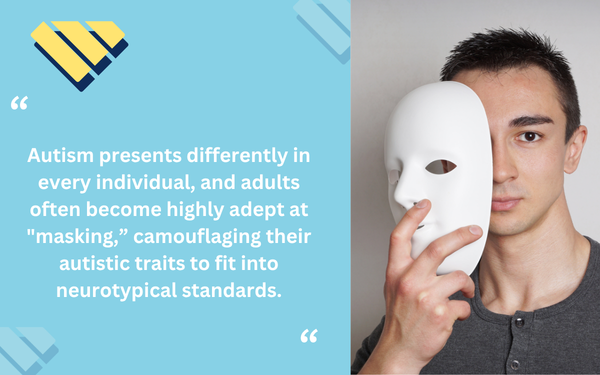
Autism presents differently in every individual, and adults often become highly adept at “masking,” camouflaging their autistic traits to fit into neurotypical standards.6 However, several core characteristics frequently prompt adults to explore assessment.7
Communication and Social Dynamics
- Feeling exhausted after casual social interactions or networking events6
- Difficulty navigating unwritten social rules, small talk or subtle body language7
- Being told you are “too direct,” overly literal or blunt in conversation7
Sensory Processing Differences
- Overwhelming sensitivity to sensory stimuli, such as loud noises, bright fluorescent lights, crowded spaces or specific clothing textures8
- Seeking deep sensory pressure or specific repetitive movements (stimming) to regulate emotions9
Executive Functioning and Need for Routine
- Strong preference for predictable routines and feeling distressed when plans change unexpectedly9
- Deep, intense focus on specialized interests or hobbies (often called “special interests”)9
- Experiencing executive dysfunction – challenges with starting tasks, organizing priorities or managing time10
| Area | Common Signs | Everyday Examples |
|---|---|---|
| Communication and Social Dynamics | Difficulty with unwritten social rules, small talk or subtle body language | Feeling exhausted after social interactions or being perceived as overly direct or literal |
| Sensory Processing Differences | Heightened sensitivity to sensory stimuli or sensory-seeking behaviors | Feeling overwhelmed by loud noises, bright lights, crowds or clothing textures, or using repetitive movements for regulation |
| Executive Functioning and Need for Routine | Preference for predictability, focused interests and executive-functioning challenges | Distress when plans change, intense focus on specialized interests or difficulty starting tasks and managing priorities |
What to Expect During an Adult Autism Assessment
Evaluating autism in adults differs from pediatric assessments. Because adults have developed years of coping mechanisms and masking behaviors, clinical evaluators take a comprehensive, nuanced approach.611
Step 1: Initial Intake and Personal History
The assessment typically begins with a detailed clinical interview. The evaluator gathers background information regarding your developmental history, childhood experiences, academic performance, employment patterns and mental health background.11
If possible, input from a family member who knew you in childhood can offer valuable perspective, though it is not strictly required.11
Step 2: Diagnostic Testing and Self-Report Inventories
Evaluators utilize standardized diagnostic instruments specifically validated for adults. These may include structured clinical assessments alongside standardized questionnaires designed to identify masking, sensory profiles and social-communication patterns.12
Step 3: Clinical Observation and Behavioral Analysis
Throughout the intake and assessment sessions, the clinician observes subtle indicators such as conversational cadence, eye contact, non-verbal cues and emotional regulation strategies.11
Step 4: Feedback and Diagnostic Report
Once testing and data analysis are complete, you will meet with the evaluator for a feedback session. They will discuss their findings, clarify whether you meet the diagnostic criteria for ASD under the DSM-5, and provide a comprehensive written report outlining personalized recommendations.13
Moving Forward After Diagnosis
Receiving an autism diagnosis as an adult can trigger a wide range of emotions such as relief, validation, grief for past struggles or excitement for a fresh start.14 It is common to take time processing what the diagnosis means for your identity.15
Post-diagnostic support can help you build a life that honors your natural strengths and needs.16
Interventions such as adult-focused Applied Behavior Analysis (ABA therapy) principles, executive function coaching, occupational therapy for sensory processing and peer support groups empower you to set healthy boundaries, manage sensory fatigue and advocate for yourself effectively in the workplace and community.1617
Blue Gems ABA Supports Everyone with Autism
At Blue Gems ABA, we celebrate neurodiversity and recognize that every individual’s journey is distinct.
While ABA therapy is widely recognized for supporting young children, the foundational principles of behavioral science are equally valuable for individuals across the lifespan seeking to build functional independence, enhance communication and achieve personal goals.
Our compassionate clinical team is committed to providing respectful, individual-centered care that honors who you are.
To learn more about our diagnostic services, behavioral support options, or resources for neurodivergent individuals, please contact us today.
Frequently Asked Questions
- Can autism be diagnosed in adulthood?
Yes. Autism can be diagnosed in adulthood when a comprehensive evaluation finds that a person meets diagnostic criteria, including evidence that relevant characteristics were present during the developmental period. - What happens during an adult autism assessment?
An assessment may include a clinical interview, developmental history, standardized diagnostic instruments, questionnaires and direct clinical observation. The exact process varies depending on the clinician and the individual being assessed. - Do I need a parent or family member to participate in my assessment?
Not necessarily. Information from someone who knew you during childhood can provide useful developmental context when available, but an evaluator can determine how to proceed when an informant is unavailable. - Can masking make autism harder to recognize in adults?
Yes. Some autistic adults camouflage or compensate for autistic characteristics in social situations, which can make those characteristics less apparent to other people. - What can an adult autism diagnosis help with?
A diagnosis may provide greater self-understanding and can help inform individualized support, treatment planning and requests for appropriate accommodations. Specific services and eligibility requirements vary by setting and individual circumstances.
References
- National Institute for Health and Care Excellence (NICE). Autism spectrum disorder in adults: diagnosis and management. https://www.nice.org/guidance/CG142/chapter/Recommendations
- PubMed. Exploring the Experience of Seeking an Autism Diagnosis as an Adult. https://pubmed.ncbi.nlm.nih.gov/36605969/
- PubMed. Anxiety and depression in adults with autism spectrum disorder: a systematic review and meta-analysis. https://pubmed.ncbi.nlm.nih.gov/30178724/
- U.S. Equal Employment Opportunity Commission. Applying Performance and Conduct Standards to Employees with Disabilities. https://www.eeoc.gov/laws/guidance/applying-performance-and-conduct-standards-employees-disabilities
- U.S. Department of Education. Students with Disabilities Preparing for Postsecondary Education. https://www.ed.gov/higher-education/students-disabilities-preparing-postsecondary-education
- PubMed Central. “Putting on My Best Normal”: Social Camouflaging in Adults with Autism Spectrum Conditions. https://pmc.ncbi.nlm.nih.gov/articles/PMC5509825/
- National Institute for Health and Care Excellence (NICE). Autism spectrum disorder in adults: diagnosis and management. https://www.nice.org.uk/guidance/CG142/chapter/Recommendations
- PubMed. In Our Own Words: The Complex Sensory Experiences of Autistic Adults. https://pubmed.ncbi.nlm.nih.gov/34255236/
- PubMed Central. Primary Care for Adults on the Autism Spectrum. https://pmc.ncbi.nlm.nih.gov/articles/PMC4851469/
- PubMed Central. Executive Function: Cognition and Behaviour in Adults with Autism Spectrum Disorders (ASD). https://pmc.ncbi.nlm.nih.gov/articles/PMC6751156/
- National Institute for Health and Care Excellence (NICE). Autism spectrum disorder in adults: diagnosis and management. https://www.nice.org.uk/guidance/CG142/chapter/Recommendations
- National Institute for Health and Care Excellence (NICE). Autism spectrum disorder in adults: diagnosis and management. https://www.nice.org.uk/guidance/CG142/chapter/Recommendations
- Centers for Disease Control and Prevention. Clinical Testing and Diagnosis for Autism Spectrum Disorder. https://www.cdc.gov/autism/hcp/diagnosis/index.html
- PubMed Central. Exploring Lived Experiences of Receiving a Diagnosis of Autism in Adulthood: A Systematic Review. https://pmc.ncbi.nlm.nih.gov/articles/PMC11937775/
- PubMed. The adult experience of being diagnosed with autism spectrum disorder: A qualitative meta-synthesis. https://pubmed.ncbi.nlm.nih.gov/38360530/
- PubMed Central. Autistic adults’ experiences of managing wellbeing and implications for social prescribing. https://pmc.ncbi.nlm.nih.gov/articles/PMC11616697/
- PubMed Central. ‘Autism is the Arena and OCD is the Lion’: Autistic adults’ experiences of co-occurring obsessive-compulsive disorder and repetitive restricted behaviours and interests. https://pmc.ncbi.nlm.nih.gov/articles/PMC11497754/
