



You hear it from the next room, a scraping, grinding sound coming from your child’s mouth. Sometimes it happens during the day, and sometimes it keeps going after they’ve fallen asleep.
Teeth grinding, known as bruxism, comes up often in conversations with parents of children with autism spectrum disorder (ASD).1 It can be hard to listen to, and it’s natural to wonder whether it’s hurting your child.
Most of the time, there are ways to find the cause and protect your child’s teeth.
In this article, we’ll discuss why autistic children grind their teeth and how parents can help.
Key Takeaways
- Teeth grinding, or bruxism, appears more common in autistic children, although the research evidence remains uncertain.
- Possible contributors include sensory seeking, stress, sleep-related factors, dental discomfort, and certain medications.
- Tracking when grinding occurs can help parents and professionals identify patterns and determine appropriate support.
- Dental evaluation helps protect oral health, while individualized behavioral strategies may help address some forms of daytime grinding.
How Common is Teeth Grinding in Autism?
Teeth grinding appears to be more common in autistic children than in their peers. A 2022 review of 15 studies found that people with autism were nearly four times as likely to have bruxism as people without it.23
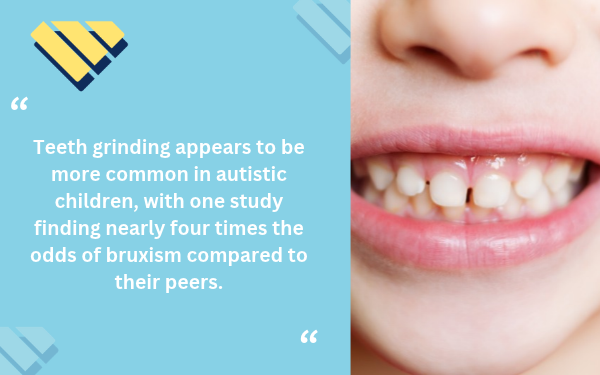
The researchers rated the evidence as low in certainty, so the exact numbers may change as more studies are done. Dentists and pediatricians who work with autistic children often report seeing it, though.
Grinding matters because of what it can do over time. Dental researchers note that bruxism may lead to worn or cracked teeth and problems with the jaw joint.4 Regular dental checkups are the best way to catch these early.
Why Do Autistic Children Grind Their Teeth?
There usually isn’t one single cause. For many children, grinding serves a purpose or happens alongside something else going on in their body.
Sensory seeking is one of the most common reasons. Clenching and grinding give the jaw strong pressure and feedback, which some children find calming or satisfying.6 In this way, grinding can work like other forms of stimming.
Stress and anxiety can also play a part. A child may grind more during transitions or when demands feel too hard. Grinding can also happen during intense concentration, such as while watching a favorite show or working on a puzzle.5
Other possible causes include:
- Sleep problems, which are common in autistic children and can come with nighttime grinding7
- Discomfort from new teeth coming in or from a dental problem8
- Side effects of certain medications, which your child’s doctor can review8
- Boredom or a need for more activity during quiet times of the day
Keeping track of when grinding happens can help you narrow down the reason. Note the time of day, what was going on and how long it lasted.
How Can Parents Help a Child Who Grinds Their Teeth?
The right support depends on why your child grinds. Here are some common situations and ideas to try.
| Possible Cause | What Parents May Notice | Ways to Help |
|---|---|---|
| Sensory seeking | Grinding during quiet time or repetitive activities | Discuss safe oral sensory alternatives with the care team. |
| Stress or anxiety | Grinding during transitions or difficult tasks | Offer breaks, predictable routines, and calming strategies. |
| Sleep-related grinding | Grinding while asleep | Discuss nighttime grinding with a pediatric dentist. |
| Dental discomfort | Grinding alongside signs of mouth discomfort | Schedule a dental evaluation. |
| Medication effects | Grinding begins or increases after a medication change | Ask the prescribing clinician to review medications. |
Dental visits can be hard for autistic children. Ask the office about shorter appointments, a quiet waiting area or a chance to visit before the actual checkup.910
How Can ABA Therapy Help?
Applied behavior analysis (ABA therapy) looks at what grinding does for your child. A Board Certified Behavior Analyst (BCBA) observes when it happens and what comes before and after, then builds a plan around that information.11
If grinding meets a sensory need, the plan may offer other ways to get the same input, such as chewing on an approved tool or eating crunchy foods at set times. If stress is the trigger, therapy can teach your child to ask for a break or use a calming strategy.1213
ABA can also help with the visits that protect your child’s teeth. Therapists often practice dental routines in small steps, such as opening wide and sitting in a reclined chair. Those steps can make checkups and cleanings much easier.14
Parent training helps you use the same strategies at home, where much of the grinding happens.
Blue Gems ABA Supports Children’s Comfort and Well-Being
Teeth grinding usually has a reason behind it, whether that’s sensory seeking or stress. Understanding the cause is the first step toward helping your child feel more comfortable.
At Blue Gems ABA, our team of experienced therapists helps children on the autism spectrum build coping and self-care skills. Each treatment plan is designed around your child’s needs.
To learn more, please contact us today.
Frequently Asked Questions
-
Is teeth grinding a sign of autism?
Teeth grinding is more frequently reported in autistic individuals, but it is not a diagnostic sign of autism. Children without autism can also experience bruxism.
-
Can teeth grinding damage my child’s teeth?
Frequent or forceful grinding can contribute to tooth wear, cracks, and jaw discomfort. A pediatric dentist can check for damage and recommend appropriate protection.
-
Why does my autistic child grind their teeth while sleeping?
Nighttime grinding can occur alongside sleep-related factors and does not necessarily have the same causes as daytime grinding. Discuss persistent grinding with your child’s dentist, especially if there are signs of pain or tooth wear.
-
Can ABA therapy help with teeth grinding?
ABA may help with some forms of daytime grinding by identifying behavioral patterns and teaching alternative skills. Dental or medical assessment remains important because not all grinding is behaviorally driven.
-
Should my autistic child wear a night guard?
A pediatric dentist can determine whether a protective appliance is appropriate based on your child’s age, dental development, and symptoms. Do not use an over-the-counter guard without professional guidance.
References
- National Institute of Dental and Craniofacial Research. Bruxism. https://www.nidcr.nih.gov/health-info/bruxism
- Granja et al. (2022). Systematic review and meta-analysis of bruxism in individuals with autism spectrum disorder. Special Care in Dentistry. https://pubmed.ncbi.nlm.nih.gov/35263459/
- Systematic review and meta-analysis (2024) examining bruxism in autistic individuals. https://pubmed.ncbi.nlm.nih.gov/38321186/
- American Academy of Pediatric Dentistry. Management of the Developing Dentition and Occlusion in Pediatric Dentistry. AAPD Clinical Guidance.
- American Academy of Pediatrics. Teeth Grinding in Children. HealthyChildren.org. HealthyChildren.org.
- Clinical review of dental problems and oral health considerations in autistic children. PubMed Central. https://pmc.ncbi.nlm.nih.gov/articles/PMC12305087/
- American Academy of Pediatrics. (2020). Identifying Infants and Young Children With Autism Spectrum Disorder. Pediatrics. AAP Clinical Report.
- National Institute of Dental and Craniofacial Research. Bruxism: Causes and Management. NIDCR.
- International Association of Paediatric Dentistry. Management of Bruxism in Children. IAPD.
- American Academy of Pediatric Dentistry. Management of Dental Patients with Special Health Care Needs. AAPD Guidance.
- Armstrong et al. (2014). Functional analysis and treatment of daytime bruxism in an adolescent with autism. Journal of Applied Behavior Analysis. https://pubmed.ncbi.nlm.nih.gov/24740489/
- Lang et al. (2013). Functional communication training and bruxism in a child with autism. Journal of Applied Behavior Analysis. https://pubmed.ncbi.nlm.nih.gov/24114107/
- Khan et al. (2024). Review of interventions for bruxism in autistic individuals. Special Care in Dentistry. https://pubmed.ncbi.nlm.nih.gov/37817388/
- American Academy of Pediatric Dentistry. Behavior Guidance for the Pediatric Dental Patient. AAPD Behavior Guidance.
