
What Triggers ‘Shutdowns’ Instead of Meltdowns?

Parents and caregivers of children with autism spectrum disorder (ASD) are often familiar with meltdowns, highly visible, externalized outbursts. Yet, there’s another equally significant response from children on the autism spectrum that’s often misunderstood or overlooked, and it’s called the shutdown.
A meltdown is often compared to a volcano of emotion, but a shutdown is more akin to a “power outage.” Understanding why a child might experience a shutdown instead of a meltdown is essential for providing the right support and interventions. By recognizing the triggers and the internal mechanics of these episodes, families can better navigate the complexities of neurodivergent emotional regulation.
In this article, we’ll discuss what triggers shutdowns in children with autism and how they differ from meltdowns.
Table Of Contents
Meltdowns vs. Shutdowns: What’s the Difference?
Meltdowns and shutdowns are both involuntary responses to sensory or emotional overload.
They are not tantrums the child uses to manipulate a situation. Rather, they are physical and neurological reactions that happen when the brain’s coping mechanisms have been completely exhausted.
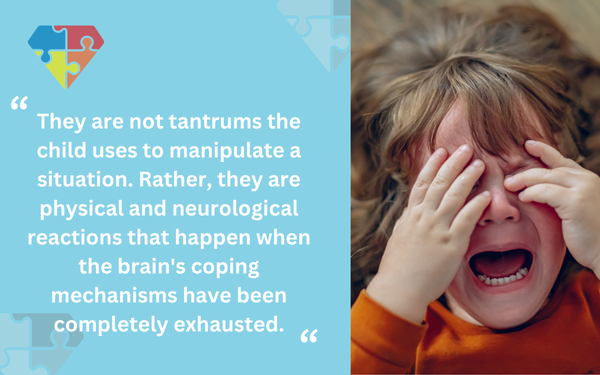
A meltdown is an external reaction that may involve crying, screaming and other movements the child does to try to expel the overwhelming emotions and energy they’re feeling.
On the other hand, a shutdown is an internal reaction. When it occurs, a child may become quiet, appear to be spacing out or not be able to communicate.
They might retreat to a corner, lay on the floor or stop responding to their name. Their body is entering a state of conservation during a shutdown, and it’s turning off non-essential functions to protect the nervous system from further input.
Common Triggers for Shutdowns
Every child who has autism is unique, but there are certain internal and environmental factors that are more likely to lead to a shutdown rather than a meltdown.
The Role of the Environment
The child’s environment plays a massive role in determining which way their nervous system will swing. Meltdowns often occur in environments where a child feels they have the space to explode or where they feel trapped and are fighting to get out.
Shutdowns are frequently triggered by environments where there is no escape. When a child feels they can’t physically leave a loud or stressful situation, their brain may create a mental escape inside instead.
This internal withdrawal is essentially a protective barrier. If a child is in a classroom or a store and realizes they can’t change their surroundings, they may simply minimize the pain of the sensory input by “going dark.”
Communication Barriers and Cognitive Load
Communication requires significant effort for many children on the autism spectrum. When they’re given a series of complex tasks to perform or asked too many questions, for instance, their cognitive load increases.
If this demand is greater than their ability to process language, a functional freeze may occur. In fact, this is a primary trigger for shutdowns in children with autism.
While some children may cry out to express their frustration, others simply stop speaking altogether. Others may misinterpret this as ignoring an adult or being defiant, but it’s really their lack of neurological ability to process audio input or retrieve words effectively.
How ABA Therapy Addresses Shutdowns
Applied behavior analysis (ABA therapy) is a highly individualized approach that focuses on understanding the function of a behavior. When working with a child prone to shutdowns, therapy teams focus on proactive strategies rather than just reactive ones.
- One of the most effective strategies in ABA is teaching children and parents to recognize the “Yellow Zone,” the period of escalating stress before a shutdown occurs. Therapists work to identify subtle signs, such as decreased eye contact, slower response times, or repetitive self-stimulatory behaviors (stimming), which indicate the child is nearing their limit.
- Because shutdowns often stem from an inability to communicate needs, ABA therapy emphasizes Functional Communication Training (FCT). This might involve teaching a child to use a break card or a gesture when they feel their battery getting low. Giving the child a way to exit a situation before the shutdown is triggered empowers them with agency over their environment.
- ABA therapists collaborate with families to modify the environment. If a child frequently shuts down at the grocery store, for instance, the therapist might suggest noise-canceling headphones or a specific, shorter mission in the store to build tolerance without reaching the point of total withdrawal.
Supporting a Child Through a Shutdown
When a child is experiencing a shutdown, remember that they’re not being difficult. They are simply unavailable at that moment.
Safety is always the priority during a meltdown. In a shutdown, though, the priority is peace.
Reduce the lights, stop all verbal demands and simply be a calm, quiet presence is to help your child “reboot.” Trying to force a child to talk during a shutdown can prolong the episode, as it adds more cognitive load to an already overloaded system.
Blue Gems ABA Proves Personalized Support for Every Behavior
At Blue Gems ABA, we understand that autism is a spectrum of experiences. Whether your child expresses their distress through outward meltdowns or quiet shutdowns, our team is dedicated to finding the why behind the behavior.
Our experienced Board Certified Behavior Analysts (BCBAs) create tailored treatment plans that respect the child’s unique sensory profile and communication style. We look at the child behind the behaviors, ensuring they have the tools they need to feel safe, understood and supported.
To learn more, please contact us today.
 617-297-7998
 617-340-3371


 English
  Spanish