
What Happens if a Child Bonds Too Strongly with One Therapist?

Consistency is often the foundation of progress for children with autism spectrum disorder (ASD). Building a trusting relationship with a Registered Behavior Technician (RBT) or Board Certified Behavior Analyst (BCBA) is a vital aspect of the success of applied behavior analysis (ABA therapy).
When a child feels safe and understood, they are more likely to engage in learning and take the risks necessary to develop new skills.
A common question that parents and caregivers often have is: Is it possible for a child to bond too strongly with a single therapist? While a deep connection is a sign of a successful therapeutic alliance, over-reliance on one individual can sometimes lead to challenges with generalization and flexibility.
In this article, we will explore the dynamics of therapist-child bonding in ABA therapy and how therapy teams ensure that a strong relationship remains a bridge to independence rather than a barrier.
- A strong therapist-child bond is essential for progress in ABA therapy.
- Over-reliance on one therapist can limit skill generalization.
- Children should learn to respond to multiple people and environments.
- ABA programs actively prevent over-bonding through structured strategies.
- Independence and flexibility are the ultimate goals of therapy.
Table Of Contents
The Importance of the Therapeutic Relationship
The priority for the beginning of any ABA therapy program is pairing.
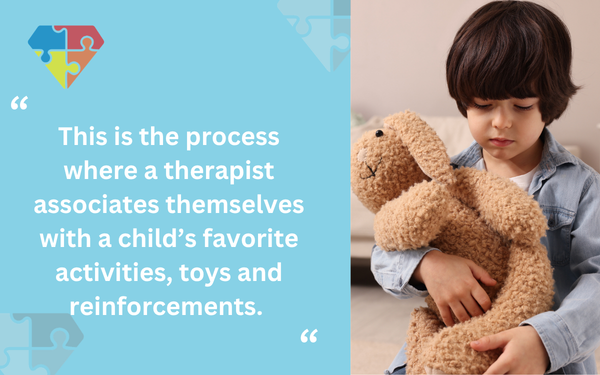
This is the process where a therapist associates themselves with a child’s favorite activities, toys and reinforcements. The goal at this stage is for the child to see the therapist as a source of fun and positivity.
A strong bond is essential because it increases motivation, reduces anxiety and improves communication.
While these are all positive outcomes, the ultimate goal of ABA therapy is for a child to use their skills in the real world with parents, teachers and peers, not just with one specific person in a therapy-based setting.
The Risks of Over-Bonding and Instructional Control
When a child becomes “over-bonded” to one therapist, it can create a bubble. You might notice that your child performs tasks perfectly during therapy sessions but struggles to follow the same instructions when given by a parent or a different staff member.
This is often referred to as a lack of instructional control across different people.
If a bond becomes too exclusive, several challenges can emerge, including difficulty with transitions, rigidity and limited generalization.
How ABA Therapy Prevents Over-Dependency
A well-structured ABA program is designed to be flexible. Clinical teams are proactive in ensuring that a child’s success is not tied to a single individual.
Here are some ways ABA therapy adapts to prevent over-bonding.
Staff Rotation
One of the most effective strategies is the use of staff rotation. By having two or three RBTs work with a child throughout the week, the child learns that the rules of communication and social interaction remain the same, regardless of who is in the room. This helps the child become more resilient and adaptable.
Systematic Generalization
ABA therapists teach skills but also specifically plan for generalization.
Once a child masters a skill with their primary therapist, the team will purposefully have another person, such as a parent or a different therapist, test the skill. This ensures the child understands that the behavior is expected universally.
Parent Training
Parental involvement is a cornerstone of ABA therapy. By participating in caregiver training, parents learn the same prompts and reinforcement techniques used by the therapist.
This transfers the bond and the progress from the clinical setting into the home, ensuring the child views their parents as effective instructional partners.
Natural Reinforcers
Early in therapy, the therapist might be the “keeper of the toys.” As a child progresses, therapists shift the focus toward natural reinforcers — the inherent reward of the activity itself or social praise.
This shifts the child’s motivation from pleasing a specific person to enjoying the mastery of the skill.
Blue Gems ABA Helps to Find the Right Balance
It is a wonderful thing when a child looks forward to seeing their therapist. It means the environment is supportive, engaging and effective.
At Blue Gems ABA, we celebrate these connections while keeping a close eye on the long-term goal of improving your child’s independence.
Our clinical teams consistently review data to ensure that skills are transferring across different environments and people. We view the strong bond between a child and their therapist as a starting point that we use to light the way toward a life of greater confidence and social flexibility.
To learn more, please contact us today.
 617-297-7998
 617-340-3371


 English
  Spanish