
ABA Strategies for Teaching Children How to Organize Their Rooms
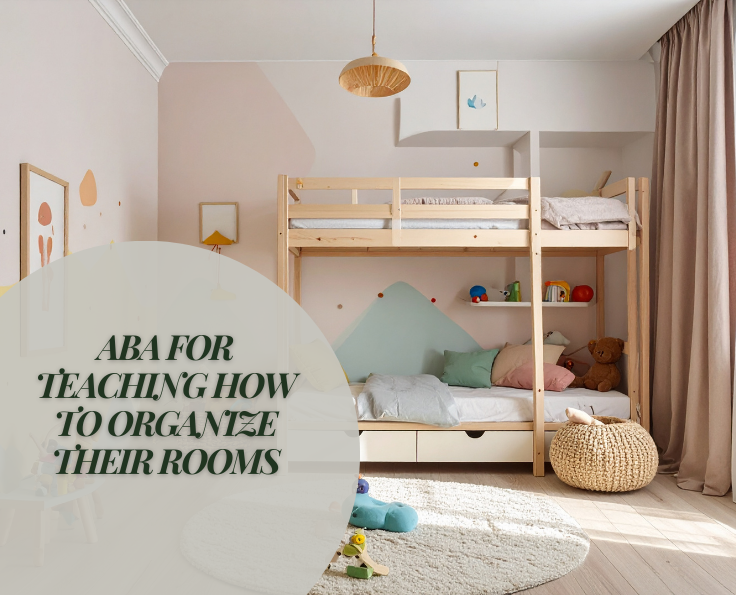
Children with autism spectrum disorder (ASD) thrive on structure. Generally speaking, they do much better when things are in order — whether that’s following a predictable daily routine or having everything in its place in their room.
Organization is great for any child, as it helps them find what they’re looking for and teaches them important skills such as matching and following directions. Children with autism may require a different type of teaching method to help them organize their rooms, though there are some easy ways to help them through it.
In this article, we’ll discuss some strategies from applied behavior analysis (ABA therapy) that you can use to help teach your child with autism how to organize their rooms.
Table Of Contents
Create a Structured Environment
First, it’s important to set up a structured environment for the child. Their things need to have a place in which they are to be put, after all.
This may take a little legwork on the part of parents and caregivers. Consider putting things such as bookshelves and other organization cabinets where they can put toys, books and other things they’re allowed in their room besides clothes.
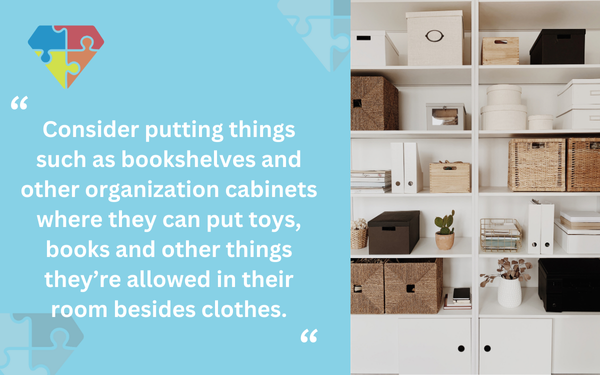
Put clear bins on the shelves of these cabinets, and label each one so the child knows what to put in each one. By designating specific bins for specific toys, for instance, your child is more likely to keep their room organized rather than just throwing everything into the same bin.
It’s also important to keep their space as calm and free from distractions as possible. Choose simple decor for the room, and set up distinct spaces that are meant for playing, reading, dressing and sleeping.
Integrate Visual Aids
Make it easier for your child to organize their room by integrating visual aids into the process. When you’re setting up the bins, for example, put a label with words describing what goes in there and accompany that with a picture.
If one bin is for toy cars, put the word “cars” on the bin and also attach a picture of a toy car. Children on the autism spectrum are visual learners, and these pictures will help them understand what is supposed to go where.
You can also provide them with a checklist for how they can organize their room at the end of each day. This visual aid helps them through the process, rather than just relying on the memory of what you told them.
As they put each item away, they can mark it off the checklist and see their progress.
Break Down the Steps
Organizing a room may sound simple to you, but it’s actually a complex task. For children with ASD, it’s best to break down complex tasks into simpler individual steps.
Doing so makes it easier for them to understand and manage, rather than expecting them to comprehend the entire process from the get-go.
Teach each of the steps one by one, and only move onto the next step once they’ve mastered the one before it. For instance, you can teach them how to fold their shirt and then put the shirt in the proper place in the dresser.
This will make it easier for your child to understand what’s expected of them.
Reinforce the Job Well Done
Positive reinforcement is a major part of ABA therapy, and it works well for teaching children how to organize their room. You can offer your child small rewards such as a token they can exchange for something they like or extra praise every time they successfully put something away.
Just like in ABA therapy, use the same reinforcer and present it in the same manner every time. The consistency will contribute to your child clearly understanding that the reinforcer is being given as a reward, which will keep them engaged and motivated in the activity of organizing their room.
Over time, following these ABA strategies will help your child generalize the skills they’re learning so that they can apply them to real-world scenarios across various environments in the future.
Blue Gems ABA Follows Proven Strategies to Teach New Skills
Children with ASD may face struggles in organizing their rooms that their neurotypical peers do not. Following ABA strategies, though, you can help your child understand what it is they need to do so they can successfully complete the task.
At Blue Gems ABA, we follow proven ABA therapy strategies to teach new skills to children on the autism spectrum and help them modify behaviors. By building personalized treatment plans that are catered to every child’s unique strengths, challenges, preferences and needs, we can be more successful in helping them live as independently as possible.
To learn more, please contact us today.
 617-297-7998
 617-340-3371


 English
  Spanish