
Why Imitation Skills Matter So Much in Early ABA
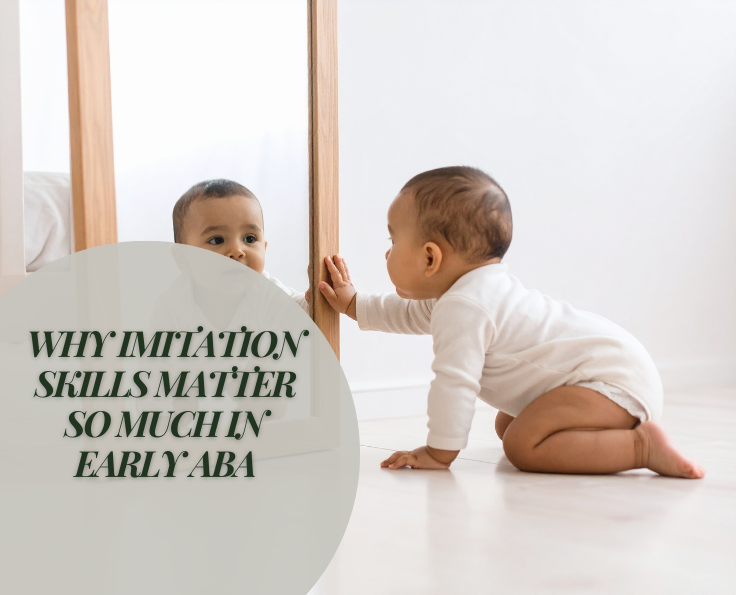
In the early stages of development, children will often imitate what they observe others doing. Smiles, glances and early gestures are usually all imitations of their parents, caregivers, siblings and others they are around a lot.
Imitation is actually a building block for cognitive and social skills. It has a profound influence on a child’s early learning, including their ability to interact and communicate with others.
This is especially true for children who may face development challenges, such as those who have autism spectrum disorder (ASD). In fact, many of the leading treatment options for children with autism, led by applied behavior analysis (ABA therapy), use imitation as one of the key components of their intervention strategies.
In this article, we’ll describe why imitation skills matter so much in early ABA therapy.
| Key Takeaways |
|---|
| Imitation is a core learning mechanism for children and essential for speech and social development. |
| Delays in imitation, common in children with ASD, can affect broader developmental milestones. |
| ABA therapy uses structured, step-by-step methods to build imitation skills starting with simple behaviors. |
| Blue Gems ABA offers customized early intervention plans to support imitation and broader skill acquisition. |
Table Of Contents
Why Are Imitation Skills So Important?
Imitation is a skill that often serves as the basic building blocks for further learning. By imitating, children can learn things such as sound words, motor skills and other complex actions.
They watch what others are doing and then copy them, allowing them to practice these skills before they even fully understand what they are.
In language development in particular, imitation is a prerequisite skill for speech. Children start by imitating the sounds that they hear, the gestures and facial expressions that they see, which then leads to more complex skills such as forming words.
Initiation skills are also key in pretend play. When children play on their own, taking stuffed animals or dolls and having them at a tea party, for instance, they are imitating skills they see others do.
They also learn things such as greeting people, waving goodbye and following instructions by imitation at first, before they fully grasp the meaning of those key skills.
For most neurotypical children, the first imitation actions begin at about 8 months old when they wave or clap their hands. By the time they reach 2, they can usually imitate a lot of different behaviors.
Yet, children with autism often lag behind in their imitation skills, which can have a profound effect on their overall development.
| Section | Key Points |
|---|---|
| Why Imitation Matters | Imitation is foundational to learning, language development, and social interaction. It allows children to practice behaviors before understanding them fully. |
| Development Milestones | Neurotypical children begin imitation around 8 months old; children with ASD often experience delays that impact broader development. |
| ABA Techniques | ABA uses modeling, prompting, fading, and structured progression to teach imitation in small, manageable steps. |
| Blue Gems ABA Role | Offers personalized, early intervention programs focused on building imitation skills in children with autism. |
How ABA Therapy Builds Imitation Skills
When children are delayed in their imitation skills, it can make it hard for them to develop language, engage with others socially and even learn positive behaviors. Imitation serves as the foundation for many more complex cognitive skills, so ABA therapy focuses heavily on it early on.
ABA therapy uses a variety of different strategies to help children with autism develop and improve their imitation skills.
Many times, it will start with modeling and prompting. Therapists will demonstrate to children different sounds, gestures or actions and then encourage them to copy what they are doing.
For instance, they may model what they want the child to do, such as humming a sound or clapping their hands. Then, they will prompt the child that it’s their turn to imitate it by pointing to them and saying “your turn.”
Over time, the therapist will fade away the prompt so that the child imitates the therapist without needing to receive a cue to do so.
ABA therapy is a structured approach to learning, so many of the strategies employed will be done in smaller steps that are more manageable for the child to understand. It will begin with simple sounds or gestures, for example, that allow the child to master that one part of the imitation before moving onto the next step.
The therapist will then progress to layering additional steps on top of one another so the child can not only generalize the imitation skill but also start to develop more complex skills from that. This is how the child can learn to say hello on their own to someone who enters the room rather than just imitating the therapist as after they do so.
Blue Gems ABA Builds Imitation Skills in Early Intervention Programs
Initiation is a key foundational skill for any child, but children with ASD may face a delay with it. Building those skills are essential, though, as imitation leads to more complex skills and development.
At Blue Gems ABA, we focus heavily on helping children with autism build imitation skills through early intervention programs. We create treatment plans for each child we support that are catered specifically to their unique strengths, challenges, preferences and needs, helping them to master the skills with which they struggle.
To learn more, please contact us today.
| FAQs |
|---|
| Why do children with autism struggle with imitation? Imitation involves attention, motor planning, and social motivation—areas that can be challenging for children with ASD. |
| When should imitation skill-building begin? As early as possible—ideally in infancy or toddlerhood through early intervention programs like ABA. |
| What does a typical ABA imitation session look like? Therapist models a behavior (e.g., clapping), prompts the child to try, and gradually fades cues as the child gains mastery. |
| Can imitation skills improve over time with therapy? Yes—consistent ABA therapy can lead to strong improvements in imitation and related cognitive, language, and social skills. |
 617-297-7998
 617-340-3371
 info@bluegemsaba.com


 English
  Spanish