
What Parents Misunderstand Most About ABA Data Graphs
Data is the foundation of applied behavior analysis (ABA therapy). As a science-based approach to learning and behavior, ABA therapy relies heavily on the collection and analysis of data so informed decisions can be made based on fact rather than conjecture.
This approach to treatment helps effectuate positive outcomes for children with autism spectrum disorder (ASD), no matter what skills or behaviors are being targeted.
After ABA therapy teams process the data that’s collected during treatment sessions, they produce ABA data graphs to make understanding what the data means easier.
Still, these data graphs can be hard to understand for parents who aren’t well-versed in what the data means.
In this article, we’ll discuss what parents misunderstand most about ABA data graphs.
Key Takeaways
- ABA data graphs require context — don’t assume causation from correlation.
- Trends are more important than final results — consistent improvement matters most.
- Short-term data can be misleading — cumulative progress shows the real story.
- Therapists can provide essential insight into what’s behind the data patterns.
- Partnering with your child’s therapy team ensures a clearer understanding of progress.
Table Of Contents
Confusing Causation and Correlation
Two basic principles of statistics are causation and correlation. Parents who see a graphical representation of a behavioral change may instantly jump to the conclusion that an intervention caused that change.
While this may indeed be the case, it’s not always true that a behavioral change on an ABA data graph was caused by the therapy itself. Instead, it could be a correlation with the interventions or because of other factors entirely.
Part of this is due to the fact that ABA graphs don’t highlight reasons why a behavior is happening or a change has occurred. To bring this into the picture requires direct input from the therapists who are working with the child in treatment.
The therapists, for instance, might be able to discuss any emotional, social or environmental triggers that may have led to the behavioral change.
| Scenario | Misinterpretation | Correct Interpretation | Parent Tip |
|---|---|---|---|
| Behavior decreases after an intervention | The intervention caused the improvement | Could be correlation — other factors like environment or emotional state might be involved | Ask therapists for context to understand contributing factors |
| Looking only at the final data point | My child hasn’t met the goal, so the therapy isn’t working | Progress is seen in trends, not just the end result | Focus on direction of progress, not perfection |
| Daily frequency looks inconsistent | Progress is unpredictable or ineffective | Daily data fluctuates — look at long-term cumulative trends | Zoom out to see bigger patterns over time |
Focusing Just on Final Points
ABA data graphs show a beginning and an end — the start of a timeframe of therapy that’s tracked and the end of it.
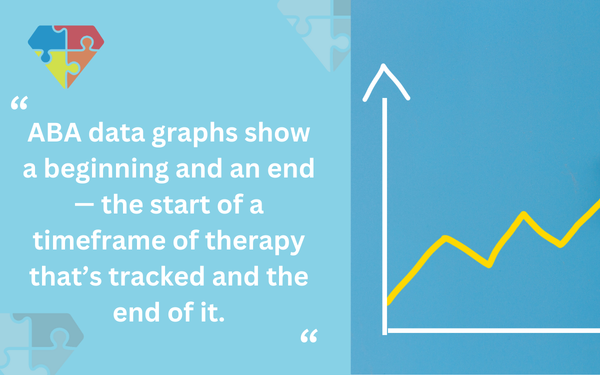
It’s easy for parents to focus only on the end data point rather than honing in on the direction that the data is trending.
The most important part of ABA therapy is that a child is making progress toward their goals. This is what shows that the interventions are working and the child is responding.
If the ABA graphs show that the child hasn’t met their goals yet — because the final points aren’t where that would need to be — it doesn’t mean that they’re not doing well.
Instead, parents should focus on whether the ABA data graphs are showing positive trends. It’s easy to just compare the start and the end, or look at the single low and high points, but that’s not always a true representation of how the child is doing.
Confusing Daily Frequencies and Cumulative Rates
Your child’s ABA therapy team will likely present you with a lot of graphical data, some of which will show more micro trends and some of which will show more macro trends.
It’s common for parents to focus on these micro trends, such as the individual daily frequencies that appear on the graph, rather than on the macro trends.
Yet, in the grand scheme of things, it’s best to concentrate on the big-picture scenario. While it’s certainly important to see how your child is doing on a daily basis, and from one day to the next, the goal is to affect change over time through ABA therapy.
This means you should focus on those macro trends, such as the change rate of a targeted behavior or skill over a longer period of time, rather than just the frequency of those desired behaviors and skills during any one particular session, or few sessions.
Blue Gems ABA Can Help Demystify ABA Data Graphs for Parents
Data graphs are an integral part of ABA therapy. They help inform therapy teams about how the interventions are going, and whether any changes are needed to the treatment plan.
At Blue Gems ABA, we work hand-in-hand with parents and caregivers to ensure they fully understand the ABA data graphs we provide them, helping to demystify some of the common confusion. Our ultimate goal is to be on the same page with parents and caregivers, as that always leads to the best possible outcomes for the children we serve.
To learn more, please contact us today.
FAQs
-
- Q: Why doesn’t the graph show why my child’s behavior changed?
A: Graphs show trends, not causes — your therapy team can explain what may have influenced the change.
- Q: Why doesn’t the graph show why my child’s behavior changed?
-
- Q: My child didn’t hit the goal. Is ABA not working?
A: Look at overall progress, not just endpoints. Gradual improvement means the therapy is helping.
- Q: My child didn’t hit the goal. Is ABA not working?
-
- Q: Why do daily data points go up and down so much?
A: Daily variability is normal. The bigger picture — long-term trends — matters more than daily changes.
- Q: Why do daily data points go up and down so much?
- Q: Should I worry about sudden dips in the graph?
A: Not necessarily. Ask your team for context — dips might be due to external triggers or normal fluctuation.
 617-297-7998
 617-340-3371
 info@bluegemsaba.com


 English
  Spanish