Using ABA for School Cafeteria Behavior
Children with autism spectrum disorder (ASD) can benefit greatly from receiving applied behavior analysis (ABA therapy) treatment. The science-based approach to learning can help children build communication, social interaction and daily life skills, while also learning to modify their behaviors.
ABA therapy has proven extremely effective at helping to support children throughout their lives, whether they’re at home or school.
During sessions, ABA therapists can help children understand the constraints of educational classrooms and what’s expected of them, and then create targeted interventions to help build skills so they can navigate the environment successfully.
While much of a child’s day in school will be very structured, there are some parts of a school day that are less so. Still, ABA therapy can be great for helping support children with autism in these situations, including on the playground or in the cafeteria.
In this article, we’ll discuss how to use ABA therapy for school cafeteria behavior.
Key Takeaways
- ABA therapy is highly effective for helping children with autism navigate unstructured environments like school cafeterias.
- Strategies like DTT and NET are used to teach and generalize skills.
- Therapists initially support children directly and gradually fade assistance to build independence.
- Positive reinforcement and play-based learning help children develop communication and social interaction skills.
- Blue Gems ABA creates customized plans to meet each child’s individual needs.
Table Of Contents
Challenges Presented During Lunch Time
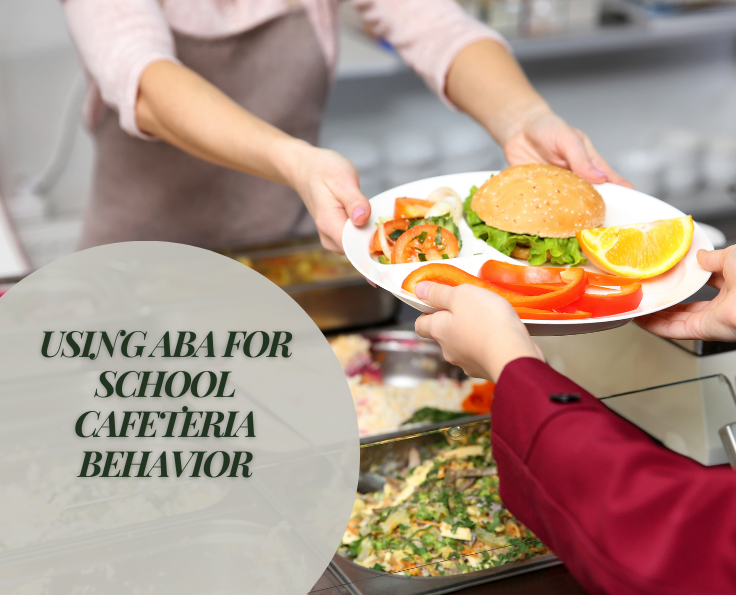
Lunch time typically provides less structure than other parts of the school day. There is usually more freedom to move around, more people present in one room, more sensory stimuli and even more choices.
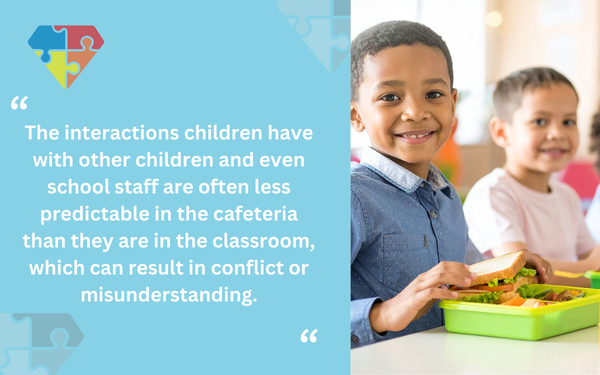
The interactions children have with other children and even school staff are often less predictable in the cafeteria than they are in the classroom, which can result in conflict or misunderstanding.
Since children on the autism spectrum often struggle with social interactions and communication, the lunchroom can present some unique extra challenges.
At the same time, the unstructured environment of the school cafeteria is a great opportunity for children with ASD to develop their social skills. Through structured ABA therapy strategies, they can build these skills and learn how to navigate unpredictable environments more successfully.
| Challenge | ABA-Based Solution |
|---|---|
| Unstructured environment | Use Natural Environment Teaching (NET) to help children apply structured skills in real-life cafeteria settings |
| Social interaction difficulties | Introduce play-based activities to teach skills like sharing, turn-taking, and cooperation with peers |
| Sensory overload or unpredictability | Gradual exposure to the cafeteria with therapist support, using prompting and positive reinforcement |
| Difficulty following multi-step routines (e.g., picking up lunch) | Implement Discrete Trial Training (DTT) to teach one step at a time, building up to complex cafeteria routines |
How ABA Therapy Helps Children with Autism Develop Social Skills
There are various ABA therapy strategies that can be used to help children with autism develop social skills and the skills necessary to navigate school cafeterias.
One is Discrete Trial Training, or DTT. This involves short trials through which children are taught different skills.
Each trial involves a prompt, the child’s response and the consequence that follows their action. For instance, the therapist may show the child a picture of a pencil and expect the child to pick up the pencil. If they complete the task successfully, they are given a reward such as extra praise or time with a toy they love.
DTT can be used to build singular skills such as picking up a pencil and then expanded to master complex, multi-step skills such as picking up their lunch in the cafeteria.
Natural Environment Teaching, or NET, can help the child apply skills that they’re learning in structured environments to more natural settings. When the child has proven they have built the basic skills necessary, NET can be implemented to make those skills more functional.
ABA therapists can also create structured activities that will teach skills such as cooperation and sharing, which can foster more positive interactions between the child and their peers. This can be done through play-based activities such as games, with the skills learned then translated over to the cafeteria environment.
ABA therapists can accompany children to the cafeteria at first, helping support them through the various steps they’ll have to complete. As they do so, they can prompt the child to give them cues and integrate positive reinforcement to reward them, and keep them engaged and motivated.
Over time, the therapist will work with the child to generalize these skills so that they can more successfully navigate the school cafeteria on their own. These improved social skills will also serve them well not only throughout their school day but throughout their entire lives.
Blue Gems ABA Helps Teach Children with Autism Appropriate Cafeteria Behavior
Children with autism may struggle with less structured school environments such as on the playground or in the cafeteria. ABA therapy can provide the structured environment to teach the skills they need to master to successfully navigate these environments.
At Blue Gems ABA, our team of experienced therapists creates personalized treatment plans that are based on each child’s unique strengths, challenges, needs and preferences. Through targeted interventions, we can help children with ASD build social and communication skills so they can live as independently as possible.
To learn more, please contact us today.
FAQs
Q: Why is lunch time especially challenging for children with autism?
A: Lunch time is less structured, noisier, and full of unpredictable social interactions, which can be overwhelming for children with ASD.
Q: How does ABA therapy help in the cafeteria?
A: ABA teaches step-by-step routines and social skills using strategies like DTT and NET to help children succeed in real-life environments.
Q: What is the role of the therapist during cafeteria time?
A: Therapists accompany children, provide prompts and support, and use positive reinforcement until the child can navigate independently.
Q: Can ABA therapy address sensory sensitivities in cafeterias?
A: Yes. Therapists gradually expose children to cafeteria settings while helping them build coping strategies in a supportive manner.
Q: Will these skills help beyond the cafeteria?
A: Absolutely. Skills developed through ABA therapy improve overall independence, communication, and social interaction throughout life.
 617-297-7998
 617-340-3371
 info@bluegemsaba.com


 English
  Spanish