
Teaching Safe Internet Use to Autistic Adolescents
The digital world offers unparalleled opportunities for connection, learning and entertainment. For adolescents with autism spectrum disorder (ASD), the internet can be a particularly valuable resource, providing a space for exploration where there aren’t the immediate pressures of face-to-face social interaction.
At the same time, this vast landscape also presents unique challenges and significant risks that require proactive and specialized support.
For autistic teenagers, navigating the online world involves understanding complex social cues, identifying potential dangers and managing impulses, skills that can sometimes be more difficult due to their autism.
Ensuring their safety online is about equipping them with the necessary skills and understanding to use the internet responsibly.
In this article, we will discuss practical, ABA therapy-informed strategies for teaching safe internet use to autistic adolescents.
Table Of Contents
The Opportunities and Risks of the Digital Landscape
Many autistic adolescents find vibrant online communities centered around shared specific interests, allowing them to build friendships and refine communication skills in a comfortable setting. Educational resources are limitless, and platforms provide creative outlets for expression.
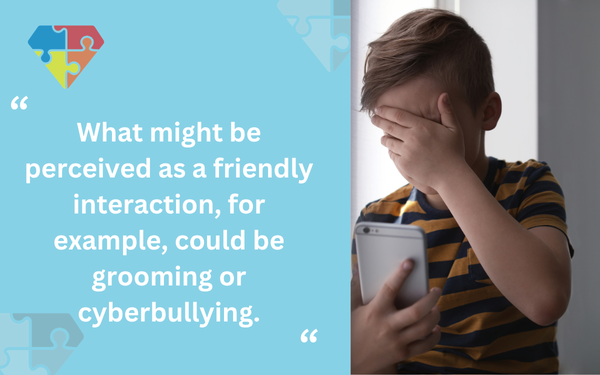
However, the lack of non-verbal cues such as tone of voice, facial expressions and body language makes interpreting online intent challenging. What might be perceived as a friendly interaction, for example, could be grooming or cyberbullying.
In addition, struggles with impulse control or difficulty recognizing dangers can make autistic teens more vulnerable to scams, inappropriate content and data privacy breaches.
The structured approach of ABA therapy is ideal for breaking down these complex and abstract online safety concepts into learnable skills.
ABA Strategies for Digital Safety
Teaching online safety is an ongoing process. ABA principles can systematically help autistic adolescents build the skills they need to protect themselves.
Here are a few examples.
Task Analysis for Breaking Down Online Interactions
Online safety comprises numerous subtle behaviors. Task analysis can be used to break these down into manageable steps. For example, instead of a broad rule such as “Be safe on social media,” we teach specific sub-skills, such as …
- Identifying what constitutes private information (full name, address, passwords, school name, current location)
- Recognizing potential warning signs in messages from strangers (asking to meet in person, requests for secrets, overly flattering language)
- Practicing the steps of creating a strong, unique password
Visual Supports and Concrete Rules
Abstract concepts such as inappropriate content or internet strangers can be confusing. Autistic adolescents often benefit from concrete rules and visual aids …
- Visual Checklists: Create a physical or digital checklist next to the computer. “Did I share my password?” “Is this person a real-life friend, a known online friend or a stranger?”
- Social Stories: Develop narratives that walk adolescents through common online scenarios such as encountering cyberbullying and receiving a suspicious link. Model the correct behavioral response such as tell a trusted adult, close the tab and do not click.
Behavioral Skills Training (BST)
Behavioral Skills Training (BST) is a powerful ABA therapy method involving instructions, modeling, rehearsal and feedback …
- Instructions: Clearly explain the safe behavior rule.
- Modeling: Demonstrate the behavior, such as by showing them exactly how to report a user on their favorite gaming platform.
- Rehearsal: Have the adolescent practice the skill in a safe, controlled setting.
- Feedback: Provide immediate feedback and reinforcement for correct responses. Role-play scenarios such as receiving a message asking for your address, showing them what to do.
Collaboration is the Key to Success
Effective digital safety plans are ones that are implemented consistently across all environments. Generalization can be challenging for autistic individuals, which is why collaboration between parents, educators and the ABA therapy team is essential.
What is taught and reinforced in a therapy session must be consistently practiced and reinforced at home and in school.
- Parent-Clinician Communication: Parents should share the specific websites, games and apps their autistic adolescent uses. BCBAs can then create highly individualized scenarios for BST and develop relevant social stories based on that actual usage.
- Consistent Reinforcement: The same vocabulary and reinforcement systems for online safe choices should be used universally. If a teen earns points for identifying a stranger danger scenario in therapy, they should receive similar praise or tangible reinforcement for correctly identifying one at home.
Blue Gems ABA Powers Safe Internet Exploration
At Blue Gems ABA, we believe that digital literacy is a critical life skill for today’s adolescents. Our approach focuses on empowering autistic teenagers to navigate the online world with confidence and security.
Our dedicated team of BCBAs works closely with families to develop individualized safety protocols tailored to your adolescent’s specific needs and interests. By integrating these essential skills into their overall treatment plan, we ensure that your teen can enjoy the benefits of connectivity while staying safe.
To learn more, please contact us today.
 617-297-7998
 617-340-3371
 info@bluegemsaba.com

 English
  Spanish