
Improving Time Estimation Skills in Children with Autism
Time estimation and management are critical skills people need to learn to successfully navigate their day. These skills are built gradually as a child gets older, but they can be extremely challenging skills for children with autism spectrum disorder (ASD) to master.
Time estimation skills are essential to complete homework, to interact with other people and to handle everything you need to in a day. Yet, the organization and planning skills that are required to do so may be more difficult for children on the autism spectrum to grasp.
Fortunately, applied behavior analysis (ABA therapy) can help children build these crucial skills so they can live as independently as possible.
Below, we’ll describe how ABA therapy helps children with autism improve their time estimation skills.
Key Takeaways
- Children with autism often face challenges with time estimation and planning.
- ABA therapy can be highly effective in teaching time estimation skills.
- Visual schedules and routines provide structured ways to understand time.
- Breaking tasks into manageable steps reduces anxiety and improves focus.
- Positive reinforcement encourages continued effort and motivation.
- Self-monitoring helps children become more independent in managing their time.
Table Of Contents
Create Consistent Routines
Individuals with autism thrive on structure, and creating consistent routines helps them feel more comfortable navigating through their day. The great part about routines is they inherently teach time estimation and management skills.
Tasks and responsibilities can be outlined on a visual schedule accompanied with pictures to highlight the order of what needs to be done that day. Putting the individual tasks on a chart with times next to them can also help the individual understand how long a certain task will take and when it’s time to move onto the next one.
It’s also a good idea to use other organizational tools to accompany the visual schedule. Depending on the individual’s needs and skill levels, these could be mobile apps, planners, calendars and/or visual timers.
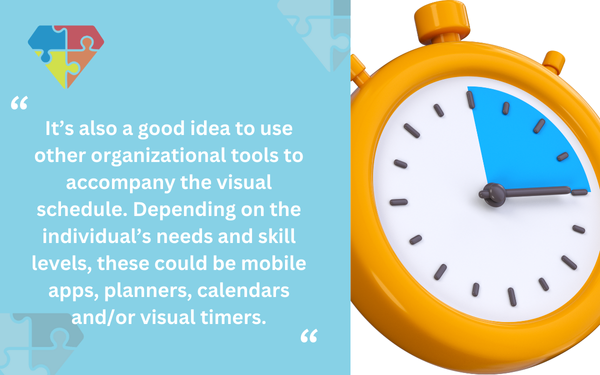
All of these things will give the individual a clear and visual representation of how much time is left on one task before moving onto the next task on the schedule.
Make Tasks Manageable
One of the core principles of ABA therapy is breaking down complex tasks into smaller and more manageable steps. This principle can be applied to routines to help individuals with autism improve time estimation skills.
Each task listed on the daily routine can be broken down into smaller steps. If the current task is the child completing homework, it can be broken down into reading the instructions, finishing one section and then reviewing their answers.
This approach to task completion can be applied to the child’s entire schedule. This will help them to not get so overwhelmed with a big list of tasks that could cause them to feel overwhelmed, stressed or anxious.
As they complete each task, parents and ABA therapists should use positive reinforcement to reward them for a job well done. This will signify to the child that they’re doing what’s expected of them, and will keep them engaged and motivated to do more.
Practice Time Estimation
A big part of teaching time estimation skills is helping children with autism see how much time a task is actually taking versus how much time they think it’s taking.
ABA therapists can work with the child to estimate how much time they think something will take. Then, as they work on the task, the therapist can use a timer to record how long it actually takes, which provides the child with a visual comparison.
This will help the child understand how they might need to adjust their schedules and plan better.
At the same time, ABA therapists can help children with autism practice focusing on tasks at hand. By removing distractions as much as possible and giving them a quiet place to work, for example, it can help the child stay on task and improve their time estimation skills.
Over time, ABA therapists can introduce self-monitoring concepts so the child can monitor on their own how much time tasks are taking them and identify any areas where they could improve. Being able to do this on their own will be critical to building strong time estimation skills so they can generalize them throughout their lives.
Blue Gems ABA Teaches Time Estimation Skills to Children with Autism
Time estimation and time management are crucial skills for all children to learn. Children with ASD may struggle more than their neurotypical peers with these skills, but they can be taught with tried-and-true principles of ABA therapy.
At Blue Gems ABA, we teach time estimation skills to children with autism through many different targeted strategies. We base treatment plans on the specific strengths, challenges, needs and preferences of each child, which ensures the treatment is as effective as possible.
To learn more, please contact us today.
Frequently Asked Questions (FAQs)
- Q: Why do children with autism struggle with time estimation?
A: Many children with autism have difficulties with executive functioning, which affects planning and predicting time needed for tasks. - Q: What is the role of ABA therapy in improving time skills?
A: ABA breaks down tasks, reinforces positive behavior, and uses visuals to teach time awareness in a structured way. - Q: Are visual schedules necessary?
A: Yes, visual schedules help children with autism understand sequence, duration, and transitions between tasks more clearly. - Q: How can parents support these skills at home?
A: By using consistent routines, visual timers, planners, and offering encouragement for task completion. - Q: When should self-monitoring be introduced?
A: Once foundational time awareness is developed, self-monitoring can be gradually taught to build independence.
 617-297-7998
 617-340-3371


 English
  Spanish