
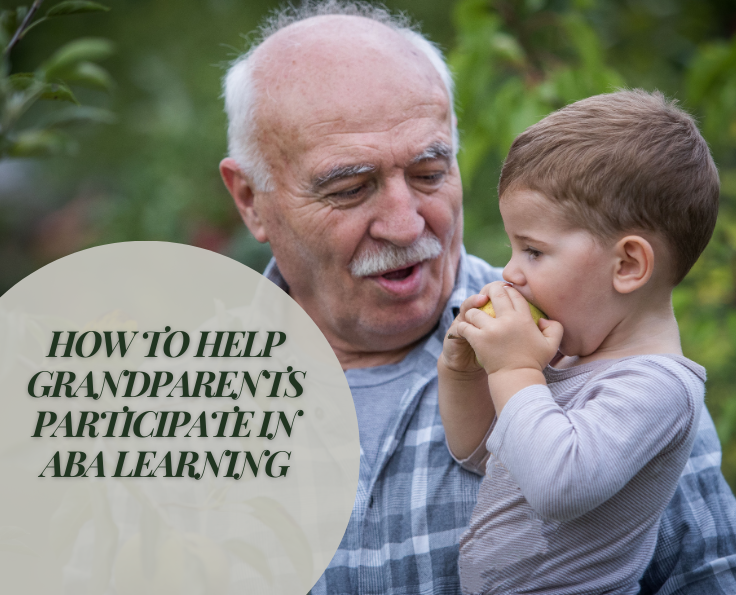
How to Help Grandparents Participate in ABA Learning
Parental and caregiver involvement is a key driver of success in applied behavior analysis (ABA therapy). The reason for this is quite simple: Parents and caregivers spend the most time with their children, so they need to know the strategies that ABA therapists use during sessions so they can best support their children outside of sessions.
ABA therapy is based on scientific evidence and data, all of which shows that children with autism spectrum disorder (ASD) thrive on routine. This concept applies not only to having a daily schedule that’s as similar as possible from one day to the next but also consistent application of the same teaching concepts.
While the obvious focus of family involvement in ABA therapy is on the parents and those who live with the child with autism, it can also prove beneficial to include other extended family members such as grandparents.
Teaching grandparents the concepts of ABA therapy, and helping them understand how they can help support their grandchildren with autism, may take a slightly different approach than for others.
In this article, we’ll discuss how to help grandparents participate in ABA learning.
Key Takeaways
- Grandparents can be a valuable part of a child’s ABA therapy support network.
- Start with education — clearly explain ABA principles and provide resources for learning.
- Hands-on involvement, such as observing and participating in sessions, increases understanding and impact.
- Setting clear, achievable roles and goals helps everyone stay aligned and confident.
- Sharing child progress and data reinforces the importance of the grandparents’ involvement.
Table Of Contents
Give Them a Baseline of Understanding
As parents and caregivers of a child with autism, you likely are well-informed about ASD in general and how it affects your child specifically. You’re also experienced with ABA therapy, the principles behind it, why your child was prescribed it, what works and what doesn’t, and how it progresses.
While grandparents may be around your child frequently, and even may witness some ABA therapy principles in action, they typically won’t have the same baseline of understanding that you do.
A good first step, then, is to provide them with this education and knowledge. Explain to them in simple terms what ABA therapy is, and emphasize that it’s based on scientific evidence and data.
Provide them with resources they can explore for more information, including articles or videos they can consume with you or on their own.
Encourage them to ask questions, provide feedback and check-in with you regularly so they can feel included in the learning as well.
Involve Them in the Training
Most people learn most effectively when they get hands-on experience with new topics. Lectures and explanations typically don’t prove to help the information “stick” as well as immersive learning experiences.
In regard to ABA therapy, this means involving grandparents into the training. Ask your child’s therapist to plan for a session or a few sessions where the grandparents will be involved.
This can start out by having them observe your child and the therapist so they can understand the mechanics of sessions and the strategies being used. Allow them to ask you questions on the side as this is happening so they can get real-time feedback.
When they’re ready, work with the therapist to design clear roles for the grandparents in ABA therapy. This will help them feel comfortable and included as they’re eased into it, while also helping your child work with a familiar person to them in what might be an unfamiliar way.
It may be a good idea to set clear goals for having grandparents participate in the ABA learning — goals that are achievable for both the child and the grandparents.
Then, over time, share with them the data and feedback that ABA therapists gather and evaluate during and after sessions to show them the progress that your child is making.
Ultimately, this could help the grandparents understand how valuable ABA therapy is to your child, and why it’s important they help support you and your child by reinforcing those principles outside of therapy sessions.
Blue Gems ABA Believes Family Involvement is a Driver of Success
ABA therapy proves more successful and sustainable when parents, caregivers and other family members have direct involvement. Doing so ensures that principles learned during sessions are reinforced outside of sessions, which helps your child eventually generalize the skills they’re learning in real-world scenarios.
At Blue Gems ABA, we believe wholeheartedly that family involvement is a driver of long-term success in ABA therapy. We work directly with parents and caregivers to integrate other family members such as grandparents into therapy sessions, designing specific and purposeful involvement for everyone.
To learn more, please contact us today.
Frequently Asked Questions (FAQs)
- Why include grandparents in ABA therapy?
- They often spend quality time with the child and can help reinforce learned skills in a loving, familiar environment.
- What if the grandparents aren’t familiar with autism?
- Start with basic educational tools and be patient — familiarity builds over time through ongoing conversations and involvement.
- How involved should grandparents be?
- Their involvement should be based on comfort, availability, and the therapist’s recommendations for their specific role.
- Can therapists train grandparents?
- Yes, ABA therapists can plan training or observation sessions to guide grandparents on how to support effectively.
- What’s the benefit of showing grandparents session data?
- It helps them feel included, see tangible progress, and appreciate their important role in therapy outcomes.
 617-297-7998
 617-340-3371
 info@bluegemsaba.com


 English
  Spanish