
How Language Choices Impact Autism Identity

The way we talk about autism spectrum disorder (ASD) is constantly evolving. For decades, professionals were the ones who dictated what language was used across schools, clinical settings and even homes.
Today, the voices of autism self-advocates are at the forefront of a conversation about how language shapes identity, self-esteem and public perception.
For parents of children starting applied behavior analysis (ABA therapy), the terminology can feel overwhelming. Some people might say “child with autism” while others prefer being referred to as an “autistic person.”
These might seem like minor differences, but the choices can carry deep meaning to some. That’s because language is a tool that shapes how a child views themselves, and also how the world views them.
Every family has a unique perspective on their child’s identity.
Below, we’ll explore the nuances of language choices in the autism community and how ABA therapy adapts to respect these personal preferences.
Person-First vs. Identity-First Language
Perhaps the most prominent debate about the subject centers on two ways of phrasing a diagnosis, either with Person-First Language (PFL) or Identity-First Language (IFL).
PFL, such as referring to an individual as a “child with autism,” was long considered the most commonly-accepted approach. The philosophy is to emphasize the person’s humanity before their disability.
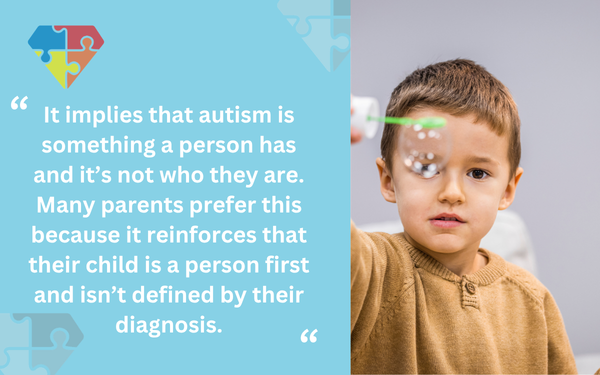
It implies that autism is something a person has and it’s not who they are. Many parents prefer this because it reinforces that their child is a person first and isn’t defined by their diagnosis.
IFL, such as referring to an individual as an “autistic person,” has gained significant momentum recently, particularly among the adult self-advocacy community.
Proponents of IFL believe that autism is an inseparable part of a person’s identity, similar to one’s race or if left-handedness. They believe that trying to separate the person from their diagnosis implies that autism is a negative trait that should be removed.
For these individuals, identifying as autistic is an expression of pride and neurodiversity.
Why Language Choices Matter in ABA Therapy
ABA therapy is highly individualized and personalized. Because it focuses on the behaviors of an individual, the language therapists use to describe those behaviors matters a lot.
When a therapy team uses language that aligns with a family’s values, it builds trust. Conversely, using language that feels clinical or is stigmatizing can create a barrier to progress.
The goal of much modern ABA therapy is to support the individual’s autonomy and self-advocacy, which begins with respecting how they choose to identify.
Moving Beyond Labels to Using Strength-Based Language
Beyond the above debate, the most impactful recent shift in ABA therapy has been the move toward strength-based language.
Historically, diagnostic reports focused heavily on a child’s deficits, or what they couldn’t do. Modern ABA therapy reframes these observations in a positive way.
Instead of labeling a child as fixated on a topic, for instance, therapists might describe the child as having a passionate interest. Instead of socially awkward, they might describe them as having a unique social style.
This new way of reframing the narrative more accurately reflects the child’s experience. When a child hears themselves described through their strengths, they develop a more resilient and positive self-identity.
In therapy, this can look like celebrating neurodivergent wins. If a child follows a unique path to solve a problem, the therapist reinforces that creativity rather than forcing a standard way of doing things, which validates the child’s identity as a neurodivergent learner.
Supporting Self-Advocacy through Language
As children grow, the most important language choice will eventually be their own.
One of the long-term goals of ABA therapy is to teach self-advocacy. This includes teaching children to express how they want to be spoken to and how they want to describe themselves.
Therapists work with children to identify their own needs and preferences. For a teenager on the autism spectrum, this might involve practicing how to disclose their diagnosis to a peer or an employer in a way that feels empowering to them.
By giving the individual the keys to their own narrative, ABA therapy helps them navigate the world with confidence in their identity.
Blue Gems ABA Supports Your Family’s Voice
At Blue Gems ABA, we understand that language is a deeply personal choice. Our team of experienced therapists is committed to listening to the families and patients we serve to ensure that the words we use reflect respect, dignity and a belief in every child’s potential.
We consistently evaluate the data of a therapy session as well as the tone and language of our interactions. Our goal is to meet your child where they are today and support the person they are becoming, while honoring the identity that makes them unique.
To learn more, please contact us today.
 617-297-7998
 617-340-3371


 English
  Spanish