
How Early Motor Delays Relate to Later Autism Diagnosis

Struggles with communication and social interactions are two of the most well-known symptoms of autism spectrum disorder (ASD). Yet, these signs often don’t present themselves in children until they are out of the infant stage and would start to interact and communicate with others.
Because of this, many children aren’t diagnosed with autism until they become toddlers, simply because their symptoms aren’t as noticeable to parents, caregivers and even professionals.
Yet, early motor delays can be one of the first predictors of an autism diagnosis down the line. There’s even a link between motor delays and deficits with communication and social interaction.
Below, we’ll discuss how early motor delays relate to later autism diagnosis.
Key Takeaways
- Motor delays can precede communication and social deficits, making them early signs of autism.
- Fine and gross motor milestones serve as crucial developmental indicators as early as 6 months.
- Motor skills are foundational to exploration, interaction, and communication development.
- Early detection through motor observation improves chances of earlier intervention.
- ABA therapy helps build motor, communication, and social skills through personalized plans.
Table Of Contents
What Are Motor Delays?
Motor skills are some of the first big developmental milestones that children achieve. This includes sitting up on their own, crawling and eventually walking.
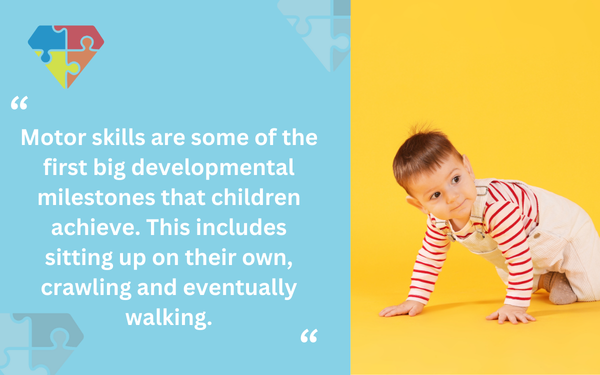
Fine motor skills such as grasping and reaching may happen even earlier than the gross motor skills.
Every child will cross these developmental milestones at different points, but there is a general timeframe in which they are considered to be developing typically.
Since some of these developmental milestones should be achieved by the time a child is 6 months old, they often serve as the first sign that the child may be developing atypically. As such, they deserve extra attention and discussion with your child’s pediatrician.
How Do Motor Delays Relate to Autism?
A delay in motor skills development does not automatically mean that a child has autism. However, it could be an early indicator, since motor delays can be directly linked to other more common symptoms of ASD.
The reason for this is that motor skills are interconnected with communication and social skills. When a child struggles with motor skills early on, it often can lead to a reduced ability to communicate effectively.
For example, if they are delayed in sitting up and crawling, then they will be limited in how they’re able to explore their world, interact with the objects around them and even engage with other people socially.
Since many fine motor skills are basic forms of communication, a delay in these skills can lead to bigger delays in communication as the child gets older. These include actions such as manipulating objects, clapping and pointing.
Are Early Motor Delays an Indication of Autism?
Delays in motor skills aren’t exclusively related to autism. That being said, they have been found to be a good predictor of future ASD diagnoses.
One study, for example, found that 70% of children who experienced a motor delay in their first two years of life ended up being diagnosed with a neurodevelopmental disorder such as autism.
Again, this doesn’t instantly mean that motor delays mean a child has autism, but it does seem to be a good predictor.
From a diagnostic standpoint, paying attention to early motor skills milestones is key, since they are often much easier to observe, monitor and track than other communication and social behaviors.
How Are Delays in Motor Skills, Communication and Social Interaction Treated?
The gold standard treatment option for children on the autism spectrum is known as applied behavior analysis, or ABA therapy. It’s a science-based approach to learning that helps children build new skills and modify certain behaviors that might be negative and/or harmful.
ABA therapy uses a variety of different techniques and strategies to target different skills and behaviors. Over time, therapists can help children build their motor, communication, social and daily life skills so they can live as independently as possible.
Since all treatment plans are built specifically for each child’s unique strengths, challenges, preferences and needs, they can be tracked through data collection and analysis and adjusted as the child grows.
The flexibility and personalization of ABA therapy is one of the main reasons why it’s so prized for helping children on the autism spectrum, no matter what their challenges might be.
Blue Gems ABA Supports Children with Early Motor Delays
Early motor delays can often be the first indicator that a child might have ASD. That’s because delays in early motor skills are directly linked to the development of social and communication skills.
At Blue Gems ABA, we have a team of expert therapists that administers ABA therapy on a one-to-one basis, helping children on the autism spectrum build their skills and manage their emotions.
To learn more, please contact us today.
 617-297-7998
 617-340-3371
 info@bluegemsaba.com


 English
  Spanish