
How ABA Teaches Polite Disagreement
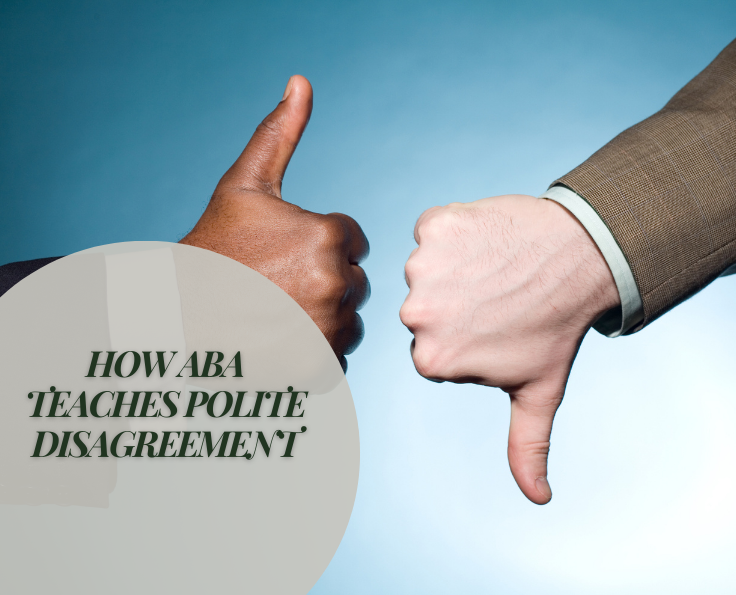
Disagreements are a part of everyday life. Being able to navigate through them successfully has a significant effect on a person’s daily life — from relationships to school progress to career advancement.
Children with autism spectrum disorder (ASD) may have trouble handling disagreements, primarily because they commonly face deficits in communication and social interactions. This can make approaching even minor conflicts very difficult.
Through applied behavior analysis (ABA therapy) treatment, children with autism can learn the skills necessary to resolve conflicts effectively and in a socially-acceptable way.
In this article, we’ll discuss how ABA teaches polite disagreement.
| Key Takeaways |
|---|
| Conflict resolution is a critical skill that can be especially difficult for children with autism due to social and communication challenges. |
| ABA therapy breaks down complex behaviors like conflict resolution into smaller, teachable components. |
| Modeling, role playing, and visual supports are core tools used by ABA therapists. |
| Children are taught not just how to disagree politely, but also how to manage their emotions when outcomes aren’t in their favor. |
| Blue Gems ABA provides personalized therapy plans to teach conflict resolution and polite disagreement skills effectively. |
Table Of Contents
Why Children with Autism Struggle with Conflict Resolution
Conflict resolution can be quite complicated. It involves balancing your own emotions, being empathetic to someone else, creatively solving problems and, at times, being able to politely disagree with another person.
What makes conflict resolution even more challenging is that many times, you need to be able to read between the lines to understand the other person’s point of view. They may not tell you how they’re feeling, for example, but you can deduce whether they’re really OK with a solution or not based on their body language.
Children with ASD often struggle with interpreting these non-verbal cues, which makes conflict resolution even more challenging. They may also have sensory sensitivities, not establish great eye contact and face other social interaction deficits that make conflict resolution hard.
| Step | Strategy | Description | Tools/Supports Used |
|---|---|---|---|
| 1 | Break Down the Skill | Teaching conflict resolution in small, digestible parts rather than all at once. | Modeling, Task Analysis |
| 2 | Model Social Behavior | Demonstrate appropriate ways to share, negotiate, and show empathy. | Therapist Modeling, Safe Practice Scenarios |
| 3 | Use Visual Aids | Visual tools help make abstract social concepts more understandable. | Social Stories, Decision Trees, Emotion Cards |
| 4 | Practice Polite Disagreement | Children rehearse polite disagreement with support. | Role Play, Positive Reinforcement |
| 5 | Manage Emotional Responses | Help children regulate emotions when conflict isn’t resolved in their favor. | Deep Breathing, Sensory Tools, Safe Spaces |
Approach Conflict in Small, Manageable Steps
A core teaching strategy of ABA therapy is breaking down complex tasks into small, manageable steps. Instead of teaching conflict resolution all at once, for example, therapists will break it down into individual steps that make it easier for children on the autism spectrum to understand.
Therapists often do this through modeling, as they demonstrate different behaviors that can lead to successful conflict resolution. Examples include sharing, negotiation and showing empathy. By presenting these behaviors to children with ASD in controlled and safe environments, therapists are able to structure the learning in a way that the children can understand.
This exposure to these behaviors helps the children become more familiar with what they are, and eventually allows them to emulate them in real-world settings in a way that’s socially acceptable.
Once the skills are understood, ABA therapists can role play conflict scenarios with children so they can learn how to apply what they’ve learned to achieve polite disagreement.
Using Visual Supports to Establish Greater Understanding
ABA therapists will also typically integrate visual supports into the teaching to help the children they’re working with establish greater understanding of conflict resolution. Examples include social stories, decision trees and emotion cards.
All of these can be used in different ways to help children understand their emotions and those of others, so that they can then identify the appropriate responses they can make when they’re in a disagreement.
What the visual aids do is take a social concept that’s rather abstract and make it more tangible. In turn, this helps the children understand non-verbal social cues better, allowing them to select appropriate responses that help them resolve conflict.
Managing Emotions for Unresolved Conflict
Not every conflict will be resolved in a way that’s completely acceptable to the child with autism. For instance, they might need to share their toy, which could make them unhappy, anxious, upset, stressed and even overwhelmed.
Even if they exhibit polite disagreement behaviors successfully, they may still be internalizing some of these emotions. That’s why it’s so important for ABA therapists to teach children how to manage their emotions for unresolved conflict.
Calming techniques may prove effective for some children, as they can learn to close their eyes and count to a certain number or practice deep breathing so they can regulate themselves.
They can also be provided with a safe place to retreat if they’re feeling overwhelmed, where they might use sensory tools such as fidget toys to calm themselves down.
Blue Gems ABA Teaches Conflict Resolution Skills
Conflict is a natural part of life, and even though children with autism may struggle with it, learning skills to navigate conflict is important. Through ABA therapy, children on the autism spectrum can build conflict resolution skills so they can more successfully navigate social situations.
At Blue Gems ABA, our team of therapists helps children with autism gain conflict resolution skills so they can manage even polite disagreements better. We build personalized treatment plans that specifically target these skills based on each child’s unique strengths, challenges, preferences and needs.
To learn more, please contact us today.
| Frequently Asked Questions (FAQs) |
|---|
| What is polite disagreement? Polite disagreement is expressing a different opinion respectfully, without anger or disrespect. |
| Why is polite disagreement hard for kids with autism? It requires interpreting social cues, managing emotions, and using verbal and non-verbal communication, which can be challenging for children with ASD. |
| How does ABA therapy help teach disagreement skills? By breaking skills into steps, using modeling and visual aids, and providing practice in controlled scenarios. |
| Are emotional outbursts still possible after learning these skills? Yes. That’s why emotional regulation is also taught as part of conflict resolution training. |
| Can these skills be transferred to school and home environments? Yes. ABA aims to generalize skills so children can apply them in various real-world settings. |
 617-297-7998
 617-340-3371


 English
  Spanish