
Helping Autistic Children Recognize Unsafe Friendships
Friendship is one of the most rewarding aspects of childhood, providing a sense of belonging, shared joy and emotional support. However, for children with autism spectrum disorder (ASD), the social landscape can be difficult to navigate.
While many children on the autism spectrum deeply desire connection, they may struggle to interpret the subtle nuances, non-verbal cues and unwritten rules that define healthy peer relationships.
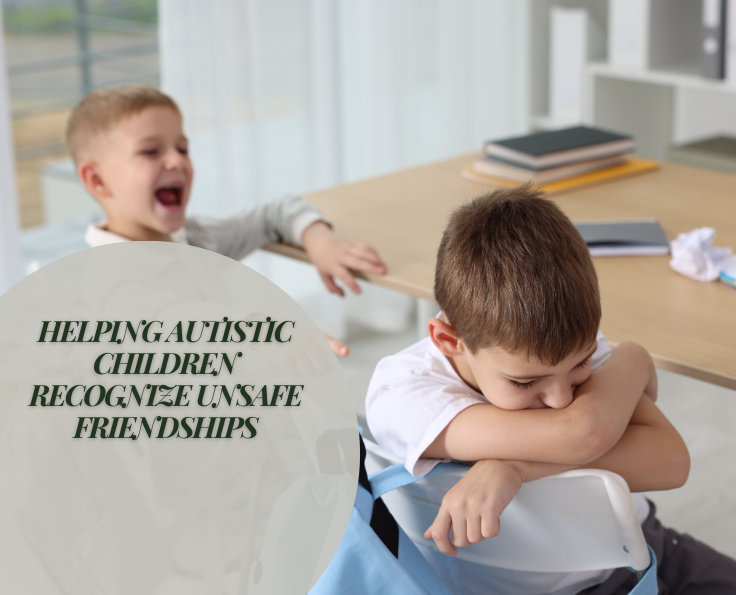
This social vulnerability can unfortunately make children with ASD targets for unsafe friendships, those characterized by manipulation, exclusion or bullying disguised as play.
Through applied behavior analysis (ABA), children can be provided with a “social compass.” By breaking down the abstract concept of friendship into observable behaviors, children can be empowered to recognize who truly has their best interests at heart.
Table Of Contents
The Challenge of Literal Interpretation
Children with autism often communicate with a high degree of honesty and take the words of others at face value. While this is a wonderful trait, it can be a disadvantage in complex social circles.
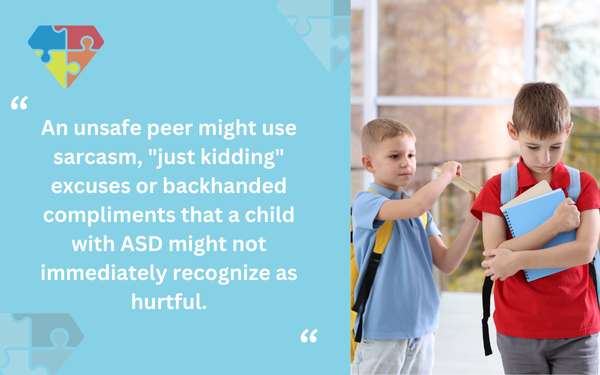
An unsafe peer might use sarcasm, “just kidding” excuses or backhanded compliments that a child with ASD might not immediately recognize as hurtful.
ABA therapy works hard on perspective-taking. Therapists help the child look beyond what is being said to focus on how the interaction makes them feel.
If a friend only wants to play when they need something, or if they ask the child to do things that feel wrong, those are objective data points that can be used to evaluate the safety of the friendship.
Identifying Red Flags in Peer Relationships
To a child who struggles with social cues, a bully can look like a friend who is simply being bossy.
ABA therapists can teach children to look for specific red flags that indicate a relationship may be unsafe, including …
- Conditional Friendship: “I’ll only be your friend if you give me your snack/toy”
- The “Joke” Defense: Consistently making fun of the child and saying “I was just joking” when the child gets upset
- Pressure to Break Rules: Encouraging the child to do something they know is wrong or dangerous
- Exclusion and Secrecy: Telling the child they aren’t allowed to play with anyone else or telling them to keep the friendship a secret from parents
By identifying these behaviors as non-negotiables, therapists give the child a clear framework to assess their peers without relying on fluctuating emotions or confusing social signals.
Visualizing the ‘Friendship Pyramid’
One of the most effective ABA tools for teaching social boundaries is the Friendship Pyramid, or the Circle of Trust.
Many children with ASD treat every acquaintance with the same level of trust and vulnerability. This can lead to sharing private information with the wrong people.
ABA therapists use visual aids to categorize people in the child’s life, such as …
- The Inner Circle: Family and very close, long-term friends who have proven they are safe
- The Middle Circle: People such as school friends and teammates we are friendly with but may not share deep secrets with yet
- The Outer Circle: Acquaintances and strangers
This visual tool helps children understand that trust is earned over time through consistent, kind behavior. It teaches them that they have the right to vet a friend before giving them full access to their emotional world.
Teaching Assertiveness and ‘The Power of No’
Recognizing an unsafe friendship is only the first step. The second is knowing how to exit the situation safely.
Many children with autism are people pleasers because they have been taught to follow adult instructions and be a good friend. This can make it very hard for them to say no to a peer.
Through Behavioral Skills Training (BST), ABA therapists use role-playing to practice assertiveness. They can create mock scenarios where a therapist acts as a peer and asks the child to do something unsafe.
They then coach the child through three steps:
- Identify the feeling: “This feels unsafe/wrong.”
- Use a firm voice: “No, I don’t want to do that.”
- Exit the area: Walk away and find a “safe” adult or a different group of peers.
Repeating these exercises builds muscle memory, so that when a real-life situation arises, the child has a rehearsed plan of action.
Empowering Parents as Social Coaches
Parents are the first line of defense in protecting their children from predatory or harmful social circles. However, it can be painful to watch a child get rejected or manipulated.
ABA therapy bridges the gap between the clinical setting and the home by giving parents coaching strategies.
Parents should be encouraged to ask open-ended questions after playdates, such as, “How did your body feel when you were playing with your friend?” or “What was one kind thing that happened today?”
This helps the child reflect on their social experiences and reinforces the lessons learned in therapy.
Build a Safe, Brighter Future at Blue Gems ABA
At Blue Gems ABA, we believe that every child deserves to feel safe, respected and valued in their friendships. Our goal is to give children with autism the discernment and confidence to choose friends who celebrate them for who they are.
By teaching children how to spot unsafe behaviors and providing them with the tools to advocate for themselves, we help them build a social life rooted in genuine connection and mutual respect.
To learn more, please contact us today.
 617-297-7998
 617-340-3371


 English
  Spanish