
Early Signs of Autism That Appear Only During Play
Spotting the early signs of autism spectrum disorder (ASD) are key to providing children with the help and the support they need. The earlier these signs are identified, the earlier children can undergo full autism evaluations by a trained professional.
Studies have shown that the earlier interventions can be started, the more effective they can be. This is why there’s such a focus on identifying the early signs of autism.
However, it can be difficult for parents and caregivers to know what is a sign of autism and what is not. Luckily, many of these can be spotted when the child plays — either independently or with others.
In this article, we’ll discuss some of the early signs of autism that appear during play.
| Key Takeaways |
|---|
| Early signs of autism can often be spotted during play activities. |
| Lack of pretend play may indicate developmental delays in imagination and social understanding. |
| Repetitive or narrowly focused play may reflect restrictive interests common in autism. |
| Sensory responses—both over and under—are often noticeable during playtime. |
| Difficulty engaging in social games may be an early sign of social communication challenges. |
Table Of Contents
Lack of Imaginative Play
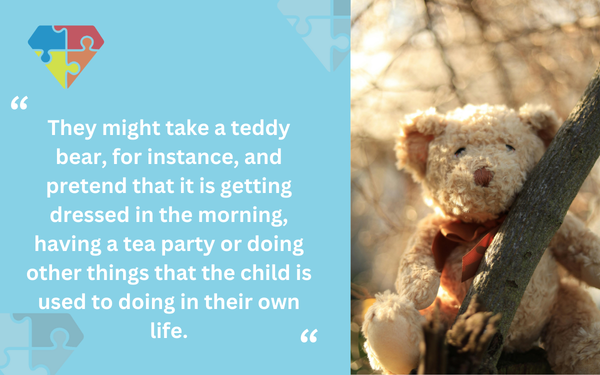
When children learn to play independently, they will often use other objects around them to pretend they are in a scenario. They might take a teddy bear, for instance, and pretend that it is getting dressed in the morning, having a tea party or doing other things that the child is used to doing in their own life.
Pretend play is a very important social skill, as it expands the child’s imagination and allows them to explore the world around them.
If your child doesn’t engage in imaginative or pretend play like this, it could be an early sign of autism.
| Sign | Description | Why It Matters |
|---|---|---|
| Lack of Imaginative Play | Child doesn’t engage in pretend scenarios with toys like tea parties or pretending a doll is getting dressed. | Suggests difficulty with creativity and social development. |
| Intense Focus | Fixates on parts of toys (like spinning wheels), lines them up, or sorts them rigidly. | Reflects restrictive and repetitive patterns of play. |
| Sensory Sensitivities | Overreacts or seeks out certain sensory stimuli like lights, textures, or sounds. | Indicates potential sensory processing differences. |
| Trouble Socializing | Avoids social games like peek-a-boo or prefers to play alone. | May indicate communication or social interaction challenges. |
Intense Focus
Another thing you might notice is that instead of playing with toys in typical ways, children with ASD might focus on only a part of the toy, such as the wheels on a vehicle or the limbs on a doll. They might line up their toys in a row, only play with their toys the same way every time and/or sort them by size or color.
This is called focused play, and it can actually be limiting in the fact that it stunts flexibility and creativity.
One of the hallmark signs of autism is restrictive interests, and it can often be spotted during early play. If you notice that your child isn’t playing with the entire toy as it is intended to be played with, then it could be a sign of ASD.
Sensory Sensitivities
There are a lot of sensory inputs that children encounter during play, which is a big reason why play is so beneficial. They can engage with different sounds, textures, lights and more in a very short period of time.
Children with ASD commonly experience sensory sensitivities. This could mean that they have trouble with things such as loud sounds, bright lights or certain textures, or it could mean the opposite — that they seek these things out.
If your child is playing and starts to cover their ears when a toy makes a loud noise, or when they respond in a different way to toys with certain textures, then it could be an early sign of autism.
Many times, children with ASD who have sensory sensitivities will become overwhelmed easily. They may throw a tantrum, act out or engage in self-stimulatory behaviors to try to calm themselves down.
Trouble Socializing
You should also pay attention to how your child engages in social play with others.
Do they seek out other children their age, or do they shy away from them? Do they want to engage with you and play social games such as peek-a-boo?
If they avoid these encounters, or if they simply have challenges engaging in this play, it could be an early sign of autism.
Many children on the autism spectrum will prefer to play by themselves, and a lot of this has to do with deficits they experience with communication and social interaction. This starts from a young age, too, even before they’re able to speak.
So, by looking out for these signs, you can potentially identify whether there’s anything to look further into.
Blue Gems ABA Supports Children with ASD
These are some of the early signs of autism that can appear during play. By paying attention to how your child plays, you may be able to bring concerns to their pediatrician so they can look into them further.
At Blue Gems ABA, we are dedicated to helping support children with ASD by administering applied behavior analysis (ABA therapy), which is the gold standard of treatment options for children on the autism spectrum. The science-based approach to learning helps children build the social, communication and daily life skills with which they typically struggle.
To learn more, please contact us today.
| Frequently Asked Questions |
|---|
| Q: What age should I start watching for these signs? A: Signs can appear as early as 12-18 months, especially during playtime routines. |
| Q: Does lack of pretend play always mean autism? A: Not necessarily. It’s one possible indicator and should be considered alongside other behaviors. |
| Q: Should I speak to a doctor if I notice these signs? A: Yes, discussing any concerns with a pediatrician is recommended. They may refer you for a formal evaluation. |
| Q: Can early intervention really help? A: Absolutely. The earlier a child receives support, the better the outcomes for their development. |
| Q: What is ABA therapy? A: Applied Behavior Analysis is a science-based therapy that helps children build communication, social, and life skills. |
 617-297-7998
 617-340-3371
 info@bluegemsaba.com


 English
  Spanish