



Children are surrounded by instructions. There are simple requests such as “please put your shoes away” and more complex, multi-step directions in settings such as a classroom.
In all environments and forms, the ability to listen, process and act upon instructions is a fundamental life skill.
For many children, this process happens naturally. However, for children with autism spectrum disorder (ASD), following instructions can be a significant hurdle that impacts their independence, social integration, academic success and more.
The difficulty often stems from challenges in communication, processing speed or executive functioning, and not from bad behavior or willfully not complying.
Applied behavior analysis (ABA therapy) provides a structured, evidence-based framework to help children bridge this gap, turning overwhelming demands into manageable, successful actions.
We’ll dive further into this topic below.
| Key Takeaways |
|---|
| Following instructions involves multiple cognitive processes that can be challenging for children with autism. |
| Difficulties are often linked to processing and executive functioning, not behavior. |
| ABA therapy uses structured, evidence-based strategies to teach these skills. |
| Breaking tasks down and using visuals can significantly improve success. |
| Consistent reinforcement helps build independence and confidence. |
Why Following Instructions Can Be Challenging for Children with Autism
Before we can understand how ABA therapy helps children follow instructions, we must first look at the hidden steps involved.
For a neurotypical child, an instruction such as “go to the kitchen and bring me a napkin” is one task. For a child with ASD, it is a sequence of events that requires…
- Auditory Processing: Hearing the words and filtering out background noise
- Language Comprehension: Understanding the vocabulary being used (knowing what a napkin is and where the kitchen is)
- Working Memory: Holding the instruction in their mind while moving from one room to another
- Executive Functioning: Planning the physical movements and resisting distractions along the way
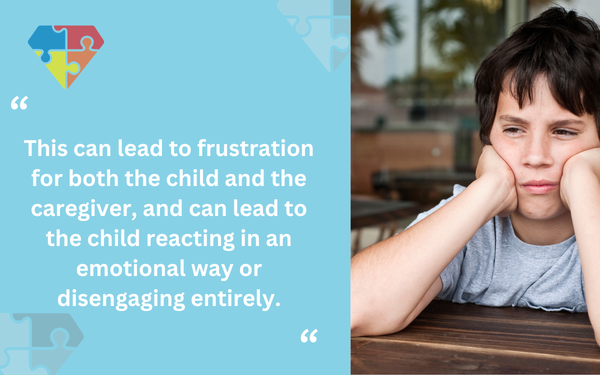
If any part of the above chain is interrupted, the child will fail the instruction. This can lead to frustration for both the child and the caregiver, and can lead to the child reacting in an emotional way or disengaging entirely.
How ABA Therapy Breaks Down Barriers
ABA therapy approaches instruction-following with the ABC model, which includes an Antecedent (the instruction), a Behavior(the child’s response) and a Consequence (what happens after).
By analyzing these three parts, therapists can identify exactly where the breakdown occurs and implement targeted interventions.
| Challenge Area | Description | Impact on Following Instructions |
|---|---|---|
| Auditory Processing | Difficulty hearing and filtering spoken language | Instructions may be missed or misunderstood |
| Language Comprehension | Struggles understanding vocabulary or concepts | Child may not know what is being asked |
| Working Memory | Difficulty holding information in mind | Steps may be forgotten mid-task |
| Executive Functioning | Challenges with planning and sequencing | Difficulty completing multi-step directions |
Core ABA Strategies for Improving Cooperation
At Blue Gems ABA, our clinicians use several techniques to help children become more proficient at following directions. These strategies are designed to build confidence and reduce the anxiety often associated with demands.
Here are some examples.
Task Analysis and Chaining
We use Task Analysis for children who struggle with complex directions. This involves taking a task such as brushing your teeth and breaking it into multiple small steps.
We then use Chaining, which involves teaching the first step and providing help for the rest or teaching the last step so the child experiences a “win” associated with finishing. This ensures the child doesn’t feel like they are failing a large, impossible task.
Visual Supports
Children on the autism spectrum are often considered visual learners, which means they often process images much faster than spoken words.
By pairing a verbal instruction with a picture card or a visual schedule, we provide a permanent reference point. If the child forgets the instruction halfway through, they can look at the visual aid rather than having to process another verbal reminder.
Errorless Learning
To prevent the frustration associated with not doing something right, therapists use Errorless Learning.
This involves providing a prompt, such as pointing to the correct object, immediately after giving the instruction, which helps ensure the child is successful every time. Over time, the therapist fades these prompts as the child becomes more independent.
Behavioral Momentum
Behavioral Momentum involves asking the child to do two or three things they love or find very easy before asking them to do something more difficult.
An example could be asking them to give you a high five or touch their nose before asking them to pick up a block.
By starting with easy wins, the child builds momentum and is more likely to cooperate with the final instruction.
Reinforcement Systems
The focus in ABA therapy is placed on what the child is doing right.
When a child follows an instruction, especially one that is difficult, they receive immediate and meaningful reinforcement. This could be extra praise, time with a favorite toy or a few minutes of brain break time.
By making cooperation a rewarding experience, we help the child develop a positive instructional history.
| ABA Strategy | How It Works | Benefit |
|---|---|---|
| Task Analysis & Chaining | Breaks tasks into small steps and teaches sequentially | Reduces overwhelm and builds confidence |
| Visual Supports | Uses images or schedules alongside instructions | Improves understanding and recall |
| Errorless Learning | Prompts correct responses immediately | Minimizes frustration and builds success |
| Behavioral Momentum | Starts with easy tasks before harder ones | Increases cooperation and engagement |
| Reinforcement Systems | Rewards successful instruction-following | Encourages positive behavior patterns |
Blue Gems ABA Helps Children Build Functional Independence
The ultimate goal of teaching children to follow instructions is to help them gain functional independence.
When a child can follow the instruction to stop in a parking lot, they are safer. When they can follow a teacher’s direction to open their notebook, they are included in the classroom.
When they can follow a recipe or a chore list at home, they gain a sense of autonomy and pride.
At Blue Gems ABA, we believe that every child has the potential to learn these vital skills when given the right tools in a supportive environment.
Our programs are tailored to the specific needs of each family, ensuring that the progress made in therapy sessions translates to real-world success at home, school and community environments.
Through patience, data-driven strategies and a focus on positive growth, we help children navigate a world of instructions with confidence.
To learn more, please contact us today.
| FAQs | Answers |
|---|---|
| Why do children with autism struggle with instructions? | Challenges with processing, memory and comprehension can make multi-step directions difficult. |
| Is it a behavior issue? | No, it is usually related to neurological processing differences rather than intentional non-compliance. |
| How does ABA help? | ABA breaks tasks into steps, uses reinforcement and teaches skills systematically. |
| What are visual supports? | They are images or schedules that help children understand and remember instructions. |
| Can these skills improve over time? | Yes, with consistent therapy and support, children can significantly improve their ability to follow instructions. |
