
ABA Strategies for Approaching New Foods at Restaurants
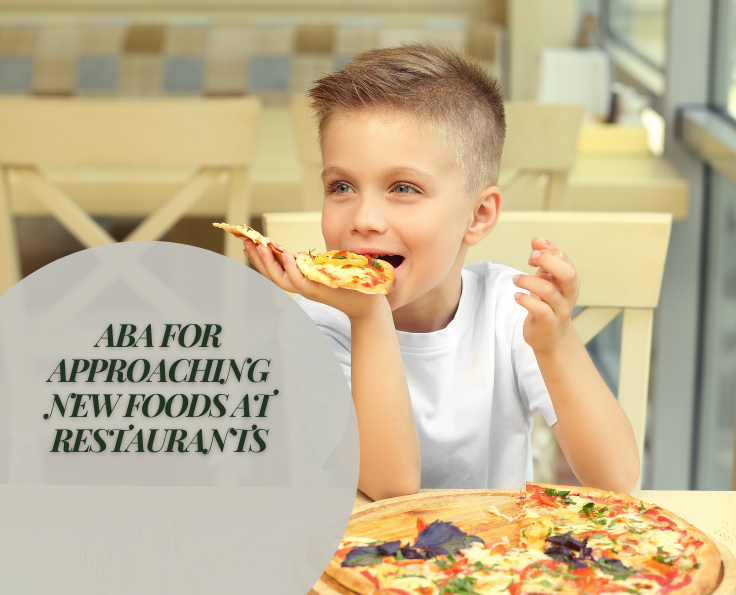
Getting kids to try new foods can be quite the challenge for any parent. This might be even more difficult for parents of children with autism spectrum disorder (ASD) due to some of the symptoms of their neurodevelopmental disorder.
It’s common for children with autism to have feeding problems. This could stem from sensory sensitivities with different textures or the fact that they have intense interests and prefer to eat the same foods repeatedly.
Getting kids on the autism spectrum to try new foods at restaurants can be even more difficult. That’s because there are added elements in place, such as a foreign and noisy environment, and the intricacies involved with reading and ordering off a menu.
Through applied behavior analysis (ABA therapy) treatment, children can learn to try new foods and get comfortable with doing so. Below, we’ll discuss some ABA strategies for approaching new foods at restaurants.
Key Takeaways
- Children with autism often face feeding challenges due to sensory sensitivities and preference for routine.
- ABA therapy provides structured, step-by-step strategies for trying new foods.
- Starting food introduction at home can reduce pressure and improve comfort levels.
- Positive reinforcement plays a key role in encouraging progress, even small steps.
- Offering choices and familiar options reduces fear and increases participation.
- Visual tools like social stories and food images reduce stress at restaurants and help build confidence.
Table Of Contents
Slow Introduction and Rewards
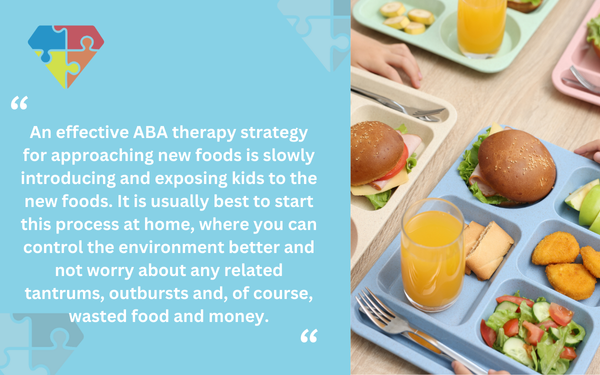
An effective ABA therapy strategy for approaching new foods is slowly introducing and exposing kids to the new foods. It is usually best to start this process at home, where you can control the environment better and not worry about any related tantrums, outbursts and, of course, wasted food and money.
ABA therapists can introduce new foods in small and manageable steps. It could involve showing the child pictures of the food at first before actually presenting them with it in person.
The therapist can model trying the new food to try to get buy-in from the child to try it as well. As the child attempts the new food, the therapist will present the child with positive reinforcement to reward them for the attempt — even if they didn’t fully try the food.
Giving the child extra praise or time with a toy they love will reward them for their behavior and keep them engaged in the therapy.
These rewards should be given any time they make progress toward trying the new food. This could be touching or picking it up, taking a small bite or even just sitting down at a table in front of the food.
Presenting the reward to them immediately will clearly signal that it’s being done as a result of their immediate previous action.
Pairing and Options
Another effective strategy for approaching new foods is to give children options and pair new food choices with ones you know they already like. If they’ve never tried an apple before but love bananas, for instance, the therapist can present them both on a plate in front of the child.
What this does is help the child feel safe around food. They will see the food that they know and like, recognize it and not get too overwhelmed — since they have a choice that they already know they like.
This strategy helps to remove some of the pressure of trying new foods by not forcing them to eat something they fear they may not like.
Building confidence in this way is also a form of stimulus fading, since the ABA therapist won’t be directly prompting the child to try the new food. They’ll be given the opportunity to do so on their own when they’re comfortable.
Visual aids
Visual aids are a big part of ABA therapy, and they can be used in a number of ways for approaching new foods.
At home, ABA therapists can create social stories that put the child in the center of the story as they try new foods at a restaurant and like them. At the restaurant, you can pair the menu with pictures of what the food is.
If the restaurant doesn’t have a menu with pictures, you can bring them with you so that the child can see their options in a visual way, which will help them become more comfortable. This removes stress and anxiety from the process and helps create a sense of predictability as well.
Blue Gems ABA Works with Children to Try New Foods
Children with ASD often have feeding issues due to the symptoms of their neurodevelopmental disorder. With the help of ABA therapy, they can overcome some of these challenges to try new foods at home and at restaurants.
At Blue Gems ABA, our team of therapists creates personalized treatment plans that cater specifically to each individual’s unique strengths, challenges, needs and preferences. This helps us design targeted interventions that work when approaching new foods at restaurants.
To learn more, please contact us today.
Frequently Asked Questions (FAQs)
- Q: Why do children with autism resist trying new foods?
A: Many children with autism have sensory sensitivities and prefer sameness, which can lead to resistance around unfamiliar foods. - Q: How does ABA therapy help in food acceptance?
A: ABA uses gradual exposure, reinforcement, and modeling techniques to reduce anxiety and build positive food experiences. - Q: What if my child refuses food at a restaurant?
A: Start food trials at home first, and bring visual aids or preferred foods to the restaurant to ease transitions. - Q: Should I force my child to try the food?
A: No. ABA emphasizes positive reinforcement and choice rather than force, helping the child feel safe and in control. - Q: How can I use visual aids in public settings?
A: Bring pictures of menu items or create a simple visual choice board to help your child navigate unfamiliar foods.
 617-297-7998
 617-340-3371


 English
  Spanish