How ABA Teaches How to Understand Gestures and Facial Expressions
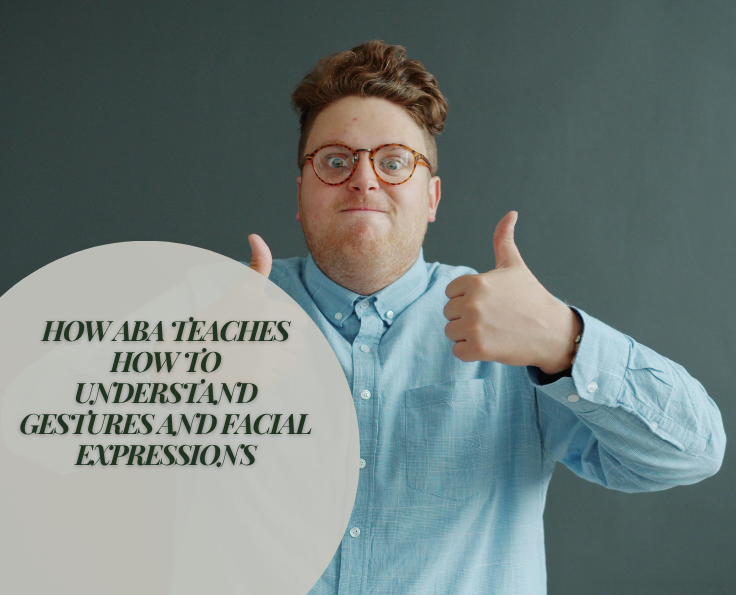
Human communication is about far more than just the words we speak. In fact, a vast majority of how we express our feelings, intentions and needs happens nonverbally through a subtle shift in posture, a wave of a hand or a fleeting facial expression.
For neurotypical children, learning to interpret these social cues usually happens naturally through observation and daily interaction.
However, for individuals with neurodevelopmental challenges, such as autism spectrum disorder (ASD), decoding nonverbal language can be incredibly complex.
A furrowed brow, a crossed pair of arms or a yawn can easily be missed or misinterpreted. Because these cues act as the unwritten rules of social engagement, struggling to understand them can lead to feelings of isolation, social fatigue and misunderstandings.
Fortunately, applied behavior analysis (ABA therapy) offers a structured, supportive pathway to help. By breaking down complex social cues into observable, teachable actions, ABA therapy empowers children with autism to better understand the world around them and connect more deeply with others.
Table Of Contents
The Challenge of Nonverbal Communication in Autism
For many children on the autism spectrum, processing a fast-paced social environment is overwhelming. While spoken words are concrete, nonverbal cues are highly dynamic and contextual.
A smile can mean someone is happy, but it can also be polite or even sarcastic. A pointed finger requires a child to look away from the speaker and follow an imaginary line to an object.
When a child struggles to process these cues simultaneously, it can impact several areas of their daily life.
● Social Interaction: Difficulty tracking whether a peer is interested, bored or upset during playtime
● Safety Awareness: Missing a caregiver’s frantic hand gesture to stop or a facial expression of alarm
● Academic Success: Misinterpreting a teacher’s nonverbal transitions, such as standing at the front of the room with arms crossed to signal it’s time to be quiet
ABA therapy meets these challenges head-on by treating nonverbal comprehension as a set of distinct skills that can be learned, practiced and mastered.
How ABA Breaks Down Gestures and Expressions
One of the core strengths of ABA therapy is its ability to take a broad, abstract concept and separate it into measurable, bite-sized components.
Through clinical data collection, individual observations and family input, a Board Certified Behavior Analyst (BCBA) designs a customized intervention plan tailored specifically to the child’s developmental level.
Here are the primary evidence-based strategies ABA therapists use to teach facial expressions and gestures.
Discrete Trial Training (DTT)
For children who are just beginning to learn nonverbal cues, therapists often utilize Discrete Trial Training. This highly structured method introduces a concept in a clear, repetitive way to build foundational recognition.
In Practice: A therapist might show the child flashcards or digital images of distinct facial expressions (happy, sad, angry, surprised). The therapist asks the child to “point to the happy face.”
When the child identifies it correctly, they receive immediate positive reinforcement. Over time, the therapist introduces more subtle variations of these expressions.
Video Modeling and Visual Supports
Because facial expressions and gestures happen in motion, static images are only the first step. Video modeling allows children to watch real-life interactions at their own pace.
In Practice: Therapists might use short video clips of people interacting. The video can be paused to analyze a specific gesture. For example, a therapist might ask, “Look at his hands, he is shrugging his shoulders. What do you think that means?”
This helps the child connect the physical movement of a shrug to the concept of “I don’t know.”
Natural Environment Training (NET)
Once a child can identify cues in a structured setting, the focus shifts to Natural Environment Training (NET). This involves taking the learned skills and applying them to organic, real-world play situations.
In Practice: During a board game or a game of catch, the therapist might purposefully look bored, look away or check an imaginary watch. The child is prompted and encouraged to notice these real-time cues: “My eyes are looking away from the game. Am I ready to keep playing, or do I need a break?”
Generalization: Bringing Skills into Everyday Life
The ultimate goal of ABA therapy is generalization, so that a skill learned with a therapist in a clinic or home setting can be successfully used at school, on the playground and with family members.
Therapy teams work closely with parents, teachers and caregivers to create a unified approach. When parents use the same positive reinforcement and prompting strategies at home, the child receives consistent feedback.
For instance, if a parent points to a shoe on the floor, they can praise the child for following the gesture: “Great job looking where I pointed!”
This collaborative effort allows the child to learn to read cues from many different people, not just their therapist.
Blue Gems ABA Supports Your Child’s Journey
Learning to navigate the nuances of human expression takes time, patience and a lot of practice. By adapting techniques to meet each individual’s unique needs, ABA therapy helps bridge the gap between isolating confusion and meaningful social connection.
At Blue Gems ABA, our team of dedicated and compassionate therapists is committed to supporting children on the autism spectrum through every stage of social development. We consistently evaluate our clients’ progress and refine our individualized treatment plans to make sure we are meeting them exactly where they are.
If you want to learn more about how we can help your child build essential social and communication skills, please contact us today.
 617-297-7998
 617-340-3371


 English
  Spanish