
How Can ABA Help with Managing Social Media Use?
In today’s digital age, social media is a primary landscape for social interaction, news and self-expression. For many children and adolescents, these platforms offer a way to connect with peers who share similar interests.
However, the unwritten rules, rapid pace and sensory intensity of social media can present unique hurdles for individuals with autism spectrum disorder (ASD).
While social media can provide a sense of community, it also introduces risks such as cyberbullying, privacy concerns and the potential for digital addiction or hyper-fixation.
Applied behavior analysis (ABA therapy) provides a structured, data-driven framework to help families navigate these digital waters. By breaking down complex online interactions into teachable skills, ABA therapy empowers individuals with autism to use social media safely and functionally.
In this article, we’ll discuss how ABA therapy techniques can be adapted to manage social media use and promote digital literacy.
Table Of Contents
The Digital Challenge for Neurodiverse Users
Social media requires a high level of executive functioning, which are the mental skills used to manage time, pay attention and switch focus.
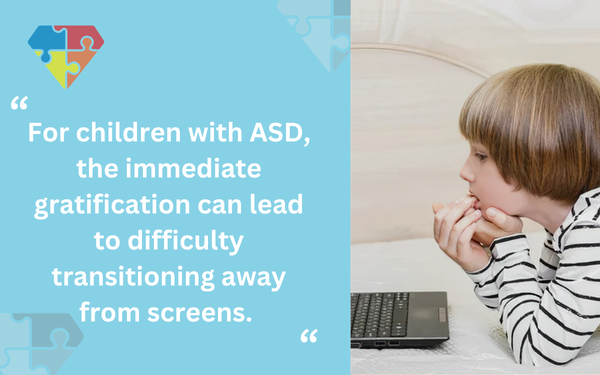
For children with ASD, the immediate gratification can lead to difficulty transitioning away from screens. Plus, the absence of physical cues such as tone of voice or body language, makes it harder to interpret the intent behind a comment or a direct message.
Common challenges include difficulty with transitions, literal interpretation, privacy awareness and social reciprocity.
How ABA Therapy Strategies Support Digital Success
ABA therapy is highly individualized. Just as a therapist would evaluate a child’s behavior in a classroom, they can evaluate a child’s behavior in a digital environment.
Here is how specific ABA strategies can be applied to social media.
Visual Timers and Schedules
One of the most effective ways to manage the infinite scroll is through clear, visual boundaries. ABA therapists often implement visual schedules that designate specific social media blocks.
Using a countdown timer provides a clear signal that the activity is ending, which reduces the likelihood of a transition-related meltdown. By making the passage of time visible, we help children develop internal regulation.
Social Stories and Video Modeling
Social media is full of nuances. A social story can be used to explain what to do if someone posts a mean comment or how to ask a friend for their username politely.
Video modeling, where a child watches a recording of someone demonstrating appropriate online behavior, is particularly effective for teaching online etiquette, such as the appropriate length of a comment or when to use a specific emoji.
Functional Communication Training (FCT)
Sometimes, excessive social media use is a way to escape a boring or difficult task.
Through FCT, we teach children to ask for a break or request a specific digital activity using their words or a communication device. This replaces problem behaviors such as sneaking a tablet with a functional request that respects the family’s rules.
Safe vs. Unsafe
Safety is the top priority for parents. ABA therapy uses discrimination training to help children distinguish between a known friend (someone they see in person) and a digital stranger.
We use sorting activities and if/then scenarios to teach children that they should never share their address, school name or passwords, regardless of how friendly a person seems online.
Building a ‘Digital Contract’
At Blue Gems ABA, we often encourage families to develop a “Digital Contract” as part of their parent training sessions.
This serves as a reinforcement system. By tying social media time to the completion of non-preferred tasks such as homework or chores, we use the Premack Principle — the idea that a high-probability behavior (social media) can reinforce a low-probability behavior (chores).
When a child follows the rules of the contract, they earn their digital time. If they struggle, the cost is a temporary reduction in that time, provided in a way that is calm, predictable and fair.
Blue Gems ABA Navigates the Digital World with You
The goal of ABA therapy is to prepare children for the world they live in, and that world is increasingly digital. We want to teach the skills necessary to use social media as a tool for connection rather than a source of stress.
At Blue Gems ABA, our experienced clinicians work with families to create technology plans that reflect their child’s developmental level and sensory needs. We monitor progress, adjust strategies and ensure that digital habits support rather than hinder your child’s overall growth and well-being.
To learn more about how we integrate modern life skills into our ABA therapy programs, please contact us today.
 617-297-7998
 617-340-3371


 English
  Spanish