
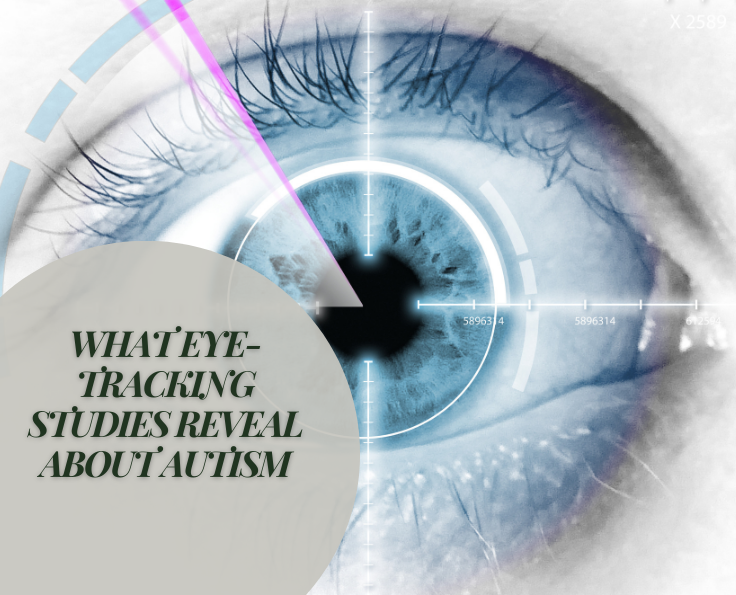
What Eye-Tracking Studies Reveal About Autism
Studying autism spectrum disorder (ASD) presents a unique challenge to researchers, since many children with autism face deficits in social interaction and communication. In other words, unlike with other groups of people, researchers may not be able to get accurate information from children on the autism spectrum by asking them questions.
Yet, advanced research has helped to shed new light on ASD in recent years. Using new technologies and new approaches, researchers have been able to glean new information about autism in ways that were not possible before.
One such way is through eye-tracking studies. These non-invasive studies don’t require direct feedback from children. Instead, researchers are able to track where the children’s eyes gravitate, which can help them understand how their brain words and how their neurodevelopmental disorder affects them on a daily basis.
In this article, we’ll dive deeper into what eye-tracking studies reveal about autism.
Key Takeaways
- Eye-tracking offers a non-verbal, objective window into how children with autism perceive the world.
- Children with autism often show reduced focus on facial cues and increased attention to geometric patterns.
- Biological motion and social signals may go unnoticed, contributing to wandering behaviors.
- Emerging data on pupil and blink response may support early ASD diagnosis.
- Early detection through eye-tracking may lead to faster, more tailored interventions.
Table Of Contents
Visual Attention
Eye-tracking studies have been used in recent years to conduct further research into early autism identification. It has proven to be an effective method, since researchers can’t rely on verbal responses from participants — either because they are too young or because they haven’t yet developed the necessary language skills to do so.
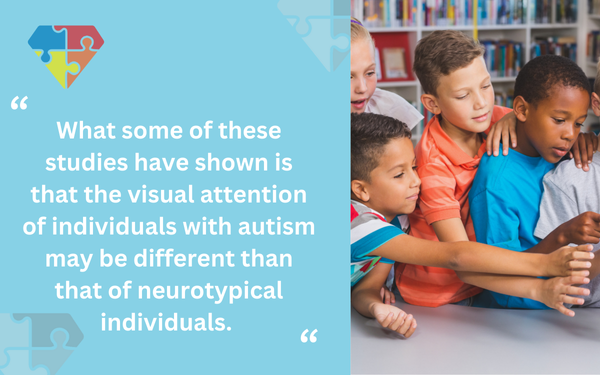
What some of these studies have shown is that the visual attention of individuals with autism may be different than that of neurotypical individuals. For instance, instead of fixating on another person’s face when they’re talking, children with autism might show a preference for fixating on geometric shapes.
In some early autism eye-tracking studies, it’s been revealed that children with autism don’t focus as much on the eye region of other people’s faces, at least compared to their neurotypical peers.
The preference for geometric shapes rather than common social stimuli may help explain why children with autism focus on other people’s mouths or other peripheral movements.
Some studies have pointed out that children with autism may also have trouble disengaging their attention from these things, which makes them seem hyper-fixated on certain objects or shapes.
Other Results
Interestingly, eye-tracking studies have revealed that children with autism may not be oriented with biological motion as much as their neurotypical peers do. For example, a child with ASD may not pick up on the rest of their classmates walking in a line toward the lunchroom and, as a result, may drift off and do their own thing.
This may help to explain why some children on the autism spectrum seem like they’re off in their own world at times, or why some are at danger of eloping. It could be because they simply don’t pick up on the social cue that the biological motion of others is giving them.
Further research is also exploring other metrics that might be able to be tracked through eye-tracking studies. This includes how the pupil responds to light or what a child’s blink rate is compared to others — both of which might serve as early indicators that a child has autism.
The Power of Eye-Tracking Studies
Eye-tracking studies can provide researchers with valuable information about autism that they might not be able to get otherwise. This information is also completely objective, since it doesn’t rely on the response of individuals but is just simple observation of how their eyes move in different situations.
Some researchers are touting the power of eye-tracking studies for the early identification of ASD in young children. Since many of the common symptoms of autism may not become prominent until the child is a few years old, eye-tracking studies could have the power of helping more effectively diagnose autism at even younger years.
In addition, eye-tracking studies could become diagnostic biomarkers for identifying autism in individuals of any age. This could become particularly valuable, especially since there are no medical exams or blood tests that can identify ASD.
With more reliable information in hand, eye-tracking studies could help support children with autism by having them start targeted interventions such as applied behavior analysis (ABA therapy) even earlier in life, when the brain is in its more neuroplastic stage.
Trust Blue Gems ABA with Your Child’s Treatment
Eye-tracking studies have shown promising results for autism identification and research. They have shown some common biomarkers of autism, which could be used to help diagnose and treat autism even earlier.
At Blue Gems ABA, we are dedicated to helping all children on the autism spectrum gain the social, communication and daily life skills with which they may struggle. By building treatment plans that are based on each child’s unique strengths, challenges, preferences and needs, we’re able to effectively help them live as independently as possible.
To learn more, please contact us today.
Frequently Asked Questions (FAQs)
- What is eye-tracking?
- Eye-tracking is a research method that monitors where and how long someone looks at visual stimuli, helping to infer cognitive and attentional patterns.
- Why is eye-tracking important for autism research?
- It allows researchers to gather objective data from individuals who may have limited language or communication skills.
- Can eye-tracking be used for diagnosing autism?
- While not a standalone diagnostic tool yet, it shows promise in identifying early markers and supplementing clinical assessments.
- Is eye-tracking safe for children?
- Yes, it’s non-invasive and does not involve any physical contact or discomfort.
- What age is best for eye-tracking studies?
- They are particularly effective with infants and toddlers, before verbal communication develops.
 617-297-7998
 617-340-3371


 English
  Spanish